

By: Nghiinomenwa-vali Hangala
In the next 4 years, the Namibian government has to repay N$36.9 billion throughout the 2026/27–2028/29 Medium Term Expenditure Framework period.
This is according to the bond maturity profile documented in the country’s Fiscal Strategy for 2027, showing that the government has 12 bonds maturing in the next 4 years. These funds are what the government has borrowed from mostly domestic investors through various bonds with the promise of reimbursement.
According to the Fiscal Strategy and the country debt profile, of the N$36.9 billion for the current FY2026/27, total maturities are projected at approximately N$10.7 billion, including significant redemptions such as the GC26 (N$1.8 billion in April 2026), the International Monetary Fund’s Rapid Fincancing Instrument facility NAM04, and GC27 bond.
“While lower than the previous year, this concentration of maturities still presents notable refinancing and liquidity demands,” acknowledged the Ministry of Finance in the Strategy, explaining that to avoid a refinancing risk, the government will commence with the switching of GC27 in early April 2026.
Within the group of maturing bonds, the government owes N$7.7 billion through the GC27, following the GC28 where it owed N$8.2 billion.
To mitigate refinancing risks and cash flow pressures, the Fiscal Strategy stated that it will deploy debt management tools including switch auctions, rollovers, and liability restructuring. This is with the promise of providing a comprehensive framework to manage the maturity profile sustainably and ensure resilient sovereign debt management.
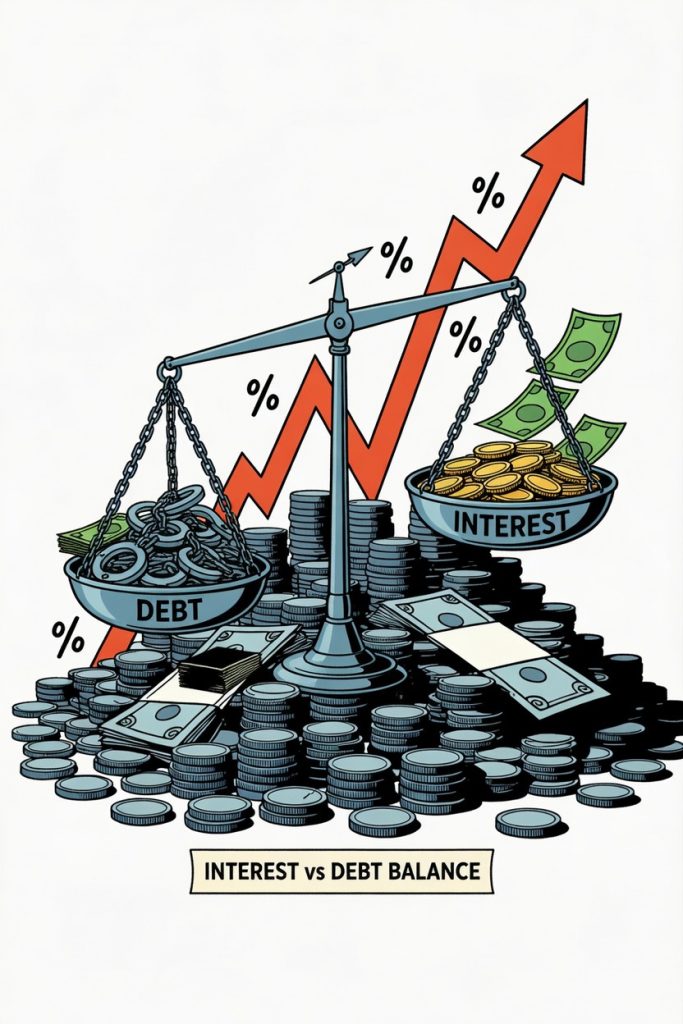
The Finance Ministry also acknowledged that despite the availability of switching options, debt servicing obligations remain a significant fiscal burden, as interest payments are estimated to rise by 9.8 percent to N$14.3 billion for the financial year starting next week.
This escalation is primarily attributed to the prevailing high-interest-rate environment and elevated borrowing requirements carried over from the preceding period, read Fiscal Strategy.
Interest payments are projected to rise to N$16,2 billion by the end of FY2026/27, continuing with the trajectory to N$17,1 billion by the end of 2027/28 and N$17,8 billion by the end of 2028/29. These interests payments average about 5.5 percent of GDP and absorb roughly 17.7 percent of revenue. The increase is primarily driven by domestic interest costs, as the rebalancing of the debt portfolio towards local-currency instruments continues.
“Meanwhile, external interest obligations remain contained due to lower debt proportion, resulting in reduced foreign-currency exposure and a shift towards concessional financing,” the Strategy read.
The country debt is expected to expand to N$193,7 billion by the end of 2026, then to N$206,7 billion in 2027/28. The government also projected that it will borrow more than N$10 billion in 2028/29, pushing debts to N$217,3 billion.
Government revenue is projected at N$89,6 billion in 2026/27, N$96,3 billion in 2028/29, and N$99,4 billion in the last year of the Framework. Key tax categories are seen as the primary drivers of said revenue projections.
According to the Strategy, Corporate Income Tax (CIT) receipts have softened significantly, largely due to the underwhelming operational performance of the diamond sector. This is compounded by a decline in Withholding Tax on Interest (WTI), most likely caused by a reduction in withholding tax on services due to a significant slowdown in oil and gas exploration activities, which influenced revenue over the past two years.
erastus@thevillager.com.na