





By: Nghiinomenwa-vali Hangala
In 2025, the highest volumes of cross-border cargo originated from South Africa (35%) and Zambia (34%), together accounting for nearly 70% of the total cross-border volumes handled through Namibian ports.
Botswana contributed 18%, while the Democratic Republic of the Congo (DRC) (10%) and Malawi (8%) made smaller but notable inputs.
This is according to the Namibian Ports Authority’s (Namport) Integrated Annual Report, which covers activities of the group between 1 April 2024 and 31 March 2025.
The report shows that South Africa is not only a trading partner, but also a dominant partner user of Namibian ports’ infrastructure.
Zambia was the second, which reflects the country’s strong mining exports and growing imports of various mining inputs and equipment.
In 2025, Botswana’s share grew on the back of copper exports.
The DRC and Malawi’s volumes were supported by copper, cobalt, and agricultural trade, whereas Zimbabwe (2%) and Angola (1%) remained marginal due to alternative routes and limited export activity.
Namibia is positioning itself as the gateway into Africa through its port infrastructure and roads.
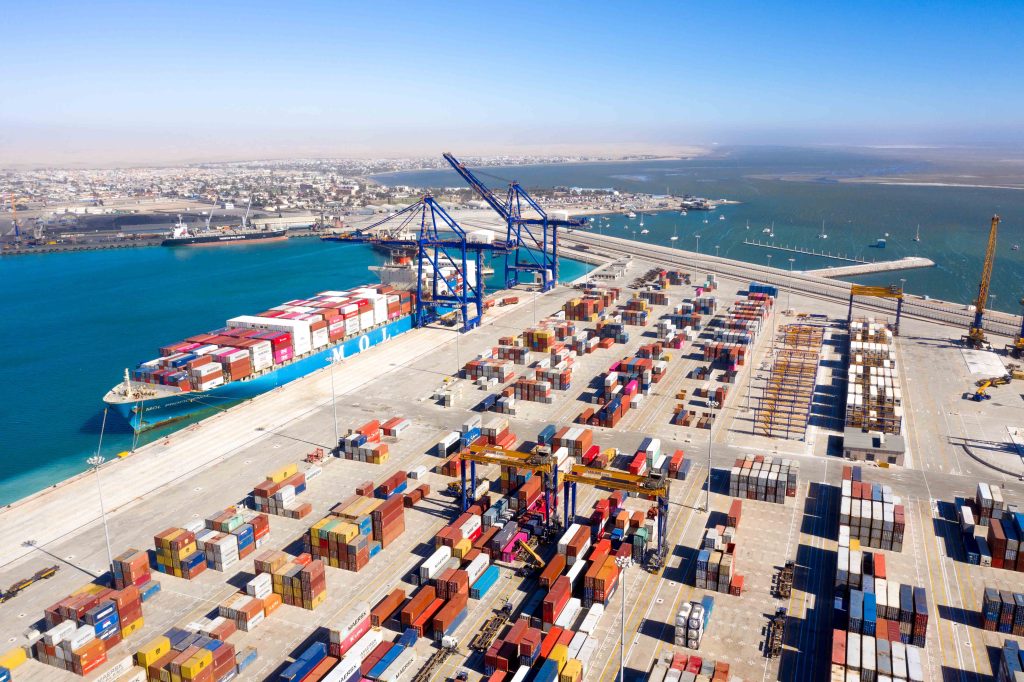
The two ports handle containerised, bulk, and break-bulk cargo across a wide range of commodities, including salt, copper, manganese, and uranium, as well as agricultural products and food products, petroleum, chemicals, vehicles, frozen goods, timber, and project cargo.
Cross-border volumes rebounded 19%, reinforcing the nation’s role as a regional gateway. Passenger liner calls and cruise activity grew materially, contributing to tourism and ancillary revenues.
Overall, cargo volumes reached 8.4 million metric tonnes, exceeding the prior year’s 8 million tonnes.
According to Namport, cross-border cargo volumes increased by 13% in 2024/25, recovering from the decline recorded in the previous year.
Growth was primarily driven by a rebound in the DRC and Botswana volumes, supported by increased mining output and stronger return cargo flows from Zambia.
Conversely, volumes from South Africa declined due to lower manganese exports.
The shortfall stemmed from fixed berth scheduling at the ports of Port Elizabeth and Saldanha, which required vessels to depart early from the Port of Lüderitz to meet subsequent port calls and complete their 60,000-tonne shipments to China.
Adding that with the commissioning of the Pekamba Warehouse, volumes are expected to grow further from Q2 of the 2025/26 financial year.
Container throughput at Namibia’s two ports increased by 48% to 253,996 TEUs, and general cargo rose 13% to 6.3 million tonnes in 2025.
According to Namport, the increase was significantly supported by the collaborative approach to business development and marketing between Namport and the private operators in the ports.
Container volumes have shown a generally upward trajectory, increasing from 155,980 TEUs in 2020/21 to 171,151 TEUs in 2023/24, despite a brief dip in 2023.
According to Namport, in 2024/25, performance accelerated sharply with concessioning, culminating in a 48% year-on-year increase to 253,996 TEUs.
General cargo volumes grew steadily over the five years, rising from 4.0 million tonnes in 2021 to 6.3 million tonnes in 2025.
The reporting year alone experienced a 13% increase, driven by import and export activities across several key commodities.
The Syncrolift repair bay occupancy rates remained on par with the prior year at 47%.
In comparison, jetty occupancy remained high, above 70%, contributing to a positive performance at the Syncrolift.
Namport was established in terms of the Namibian Ports Authority Act (Act 2 of 1994).
Today, Namport operates the Port of Walvis Bay and the Port of Lüderitz, positioning itself as a strategic enabler of trade and logistics for Namibia and the wider Southern African Development Community (SADC) region.
The company’s mandate is to manage and oversee port operations, lighthouses, and navigational aids within Namibia’s territorial waters.
The mandate also includes providing safe, efficient, and competitive port facilities and services and to conduct business on sound commercial principles that safeguard long-term sustainability.
Through its ports, Namport facilitates both domestic and cross-border trade via four strategic corridors that directly link Namibia to regional markets.
These are the Trans-Kalahari Corridor, which connects Namibia with Botswana and South Africa.
The Walvis Bay–Ndola–Lubumbashi Development Corridor, linking Namibia with Zambia, Zimbabwe, and the Democratic Republic of the Congo.
The Trans-Cunene Corridor provides access to Angola, and the Trans-Oranje Corridor provides access to South Africa.
Namport is also a founding member of the Walvis Bay Corridor Group (WBCG).
This public–private partnership promotes Namibia’s transport corridors and ports as
efficient and cost-effective gateways to regional and international markets.
Looking ahead, Namport has indicated that its priorities are to lock in productivity gains, enhance the customer value proposition through dependable transit times, and achieve competitive total logistics costs.
Moreover, to continue the transition to a landlord port authority model, one that attracts investment, drives job creation, increases volumes, and fosters innovation.
This would support Namibia’s transformation into a gateway economy, reinforcing its
role as a catalyst for regional competitiveness, inclusive growth, and long-term sustainability.