


Isabel Infantes – Pool Reuters
By: David Shoombe
Amid global uncertainty and rising fuel and commodity prices, the Group of Seven (G7) Summit draws attention as a platform to address global security, economic imbalances, and competition.
The summit is being held in Évian-les-Bains, France from 15-17 June 2026.
Originally a gathering of seven of the world’s most powerful economies, the G7 Summit has long served as a key forum in global relations, shaped by economic cooperation and security alignment.
However, with Africa and much of the Global South not participating, the resulting exclusion and fragmentation of multilateral institutions raises questions about global security and economic stability, particularly for developing regions.
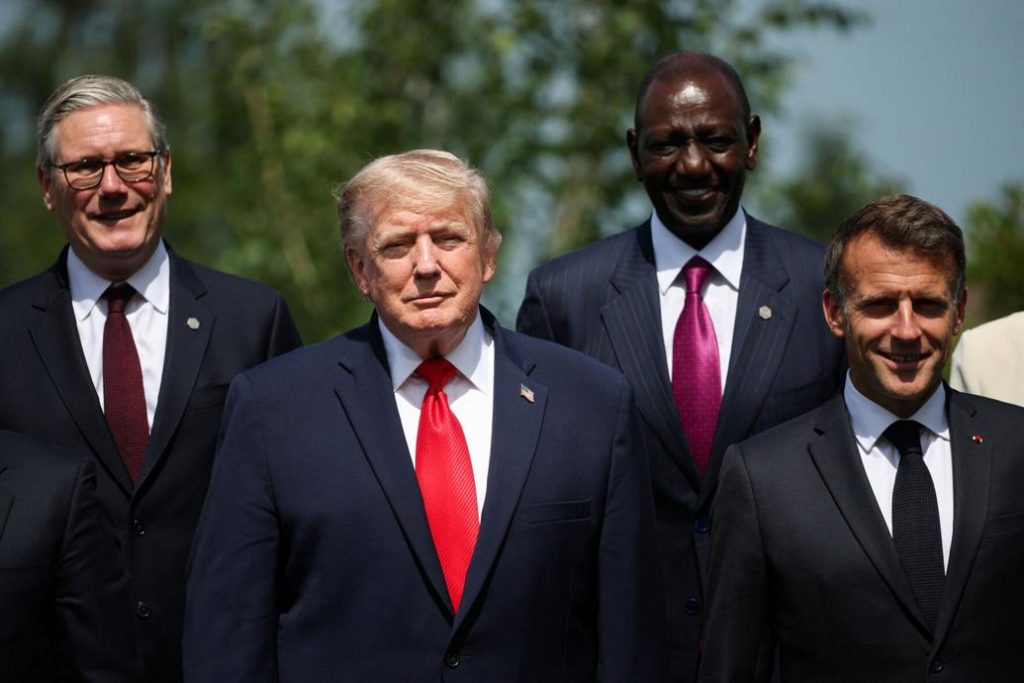
During a meeting with leaders from France, Canada, Germany, Italy, Japan, the United Kingdom, and the European Union, U.S. President Donald Trump stated that the Middle East situation was evolving positively and expressed optimism that the Strait of Hormuz would remain open following a peace agreement expected to be signed on 19 June.
As a result, global crude oil prices are expected to decline by about 4%, reflecting market confidence in a potential U.S.–Iran peace agreement and the outcomes of the G7 Summit.
Africa remains excluded from discussions on global security and critical minerals, even in an observer’s capacity. This limits the continent’s representation in discussions on matters directly affecting its interests.
An economic scenario report by the African Development Bank showed that a six-month extension of the Middle East conflict could increase civil unrest in Africa, particularly in countries already prone to violence, driven by rising oil prices.
The Global Terrorism Threat Assessment of 2026 notes that “Nearly 80 percent of global Islamic State activity recorded by ACLED in the first 11 months of 2025 took place in Africa, a significant increase from nearly 50 percent in 2024.”
The report adds that “The Middle East remains a hotbed of terrorism, but the most capable groups have been focused on local and regional objectives. The Middle East is home to important U.S. allies, including Israel and Saudi Arabia, and their security remains a U.S. concern. Therefore, while some threat to the U.S. homeland emanates from the Middle East, the most immediate concerns for US policymakers are regional.”
Ultimately, the outcomes of the G7 Summit are of interest to Africa, as peace in the Middle East is economically beneficial to the continent due to its high oil dependency. Instability in the region can contribute to debt burdens, civil unrest, and uncertainty across African states.
Moreover, summit discussions on critical minerals will affect the continent’s future trade and economic prospects.