


By: Helmut Mahongo
Observations by the United Nations are that artificial intelligence (AI) is advancing at runaway speed.
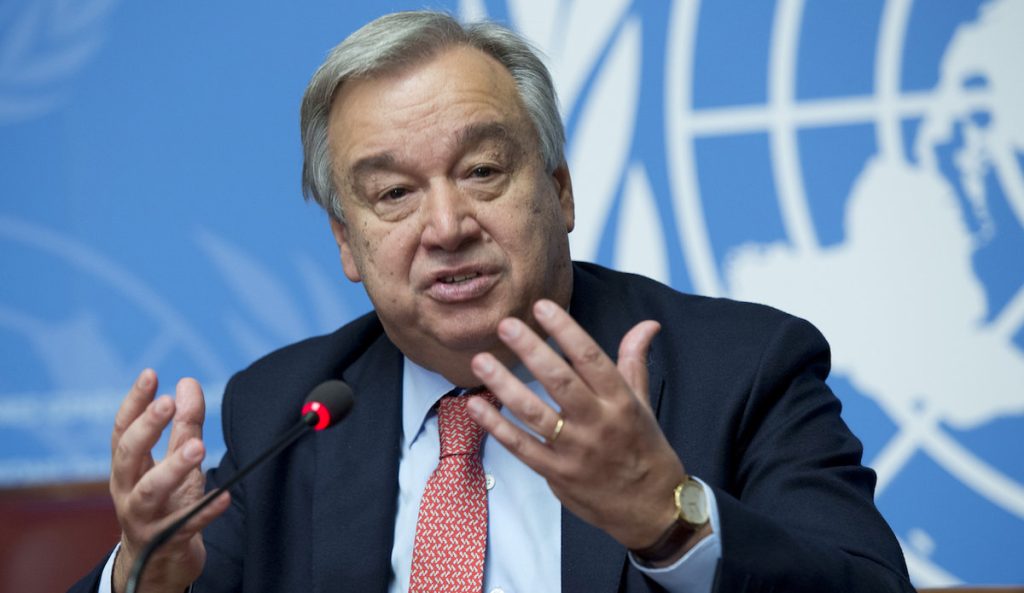
The global body’s Secretary-General, António Guterres, noted that AI technology can reshape economies, transform the world of work, sway elections, and tilt the balance of security, “AI is being deployed faster than anyone, including the people building it, can keep up,” Guterres said.
Guterres noted this during his opening speech at the inaugural UN Global Dialogue on AI Governance in Geneva, Switzerland on Monday.
In the same speech, the UN chief, a physicist, warned that the science (of AI) carries three warnings; the first is about speed.
By comparing the speed with which internet use spread around the world to that of AI, Guterres said, “the internet took fifteen years to reach a billion people, AI got there in two.”
On the governance challenges being presented by AI, Guterres said, “most nations, including many developing countries, have had no say in decisions that will shape their futures.”
On this he called for a swift, inclusive way forward, warning that, “the longer we wait, the harder that concentration sets, when power imbalances are hard-wired into technology, inequality becomes part of the code.”
This is not the first time Guterres has spoken out about the observable intertwining of technology and governance.
In his 2026 priorities press conference given in January of this year, Guterres said, “We are witnessing perhaps the greatest transfer of power of our times, not from governments to people, but from governments to private technology companies.”
He also warned in the same press conference that, when technologies that shape behaviour, elections, markets, and even conflicts operate without guardrails, the reaction is not innovation; it is instability.
Guterres, concluding his opening speech at the Global Dialogue on AI, said the concern is not on innovation but safety and inclusivity. “Some might claim that governance is the enemy of innovation, but innovation needs guardrails,” he said.
He pointed more at the wider application and thus the need for regulations.
Saying that the technologies humans trust most in aviation, in medicine, in nuclear energy and beyond earned that trust because the society acted to hold their makers to account.
“If AI is to be trusted, those who build it must be accountable,” he noted.
On inclusivity, Guterres said if AI is to be global, it must be fair, and if AI is to serve the future, it must not consume the future.
To ensure that AI serves the future instead of destroying it, “that will require governments to act with urgency, we may be the last generation able to set the terms on which humanity and machines coexist,” said the UN chief.
The UN Chief is by no means the only global leader who has concerns on technology and AI in particular.
In May of this year, Pope Leo XIV published his first encyclical, titled Magnifica Humanitas (Magnificent Humanity).
The encyclical points to the concerns surrounding technological advancement, stating that “in themselves, these innovations can greatly serve integral human development and the care of our common home (earth).”
The document continues to state that, because of their power (technological innovations), they can also hasten the expansion of the technocratic paradigm and therefore require a new spiritual, ethical, and political framework.
In response to the encyclical, American billionaire tech investor Peter Thiel, while speaking at the Aspen Ideas Festival, accused Pope Leo XIV of serving as a “Chinese communist agent” for calling for AI regulation, according to a CNN report.
The AI Dialogue is set to ensure that governance reflects the priorities and benefits of AI for all nations and not just the most technologically advanced, according to the UN.