



By: Dwight Links
The first Circular Economy Dialogue recently held in Windhoek outlined the hidden gems in the sustainable use of materials and minerals, particularly around the partnerships and bilateral relations existing between northern and southern hemisphere nations.
Deputy vice-chancellor of the Namibia University of Science & Technology (NUST), Colin Stanley, indicated that the institution has partnered with Finnish universities to grow this particular field of sustainable resource management. He cited that these partnerships allow Namibia to strengthen its pursuit of optimal mineral value addition through research and development.
“Among these collaborations is the strategic initiative with Tampere University. This particular project ran from 2022 to 2024 and undertook a feasibility study which aimed to establish a centre of excellence for African civil aviation in Namibia,” stated Stanley.
This planned centre would aim to advance aviation innovation, safety, and systems resilience across the continent. Named the AiRRHow Aviation Centre, it would help Namibia in Unmanned Aircraft Vehicle and drone technology development.
Stanley noted that the aviation sector is a difficult one to participate in, but that its transformation is essential for the circular economy and achieving a climate-smart future.
“The opportunities being explored would be in resource efficient aviation management, circular maintenance and refurbishment practices for aircraft digital solutions that reduce material wastage and the current development for a greener, more efficient African aviation ecosystem,” the deputy vice-chancellor noted.
The Finnish Innovation Fund, SITRA, promotes the ideas and innovations behind the concept of the Circular Economy. SITRA representatives were also present during the dialogue to outline some of the key developments they have formed part of across the world.
The organisation is also a backer of the annual World Circular Economy Forum (WCEF) which has been hosted by India, Japan, Brazil and Rwanda (first African host) since 2017 when it commenced in Helsinki, Finland.
Finnish ambassador to Namibia, Katja Kalamäki, said the circular economy is an important theme for Finland as it does not only represent an environmental agenda, but also an economic transformative one.
“This helps with building a knowledgeable economy, resource optimisation, and discovering the methods of creating more value without using virgin materials from natural resources,” Kalamäki added.
She noted that the Finnish government has promoted the concept of the circular economy to many parts of the world, including South America and South Asia.
Representing Finland’s Ministry of Foreign Affairs, Jukka Pajarinen noted that global economies have, for the most part, followed the linear model of the unsustainable concept of ‘take, make and waste.’
“We extract resources and make them into products, and eventually discard them. In a world of a growing population, limited natural resources and growing environmental pressures, this model is no longer sustainable,” highlighted Pajarinen.
Expanding on the importance of changing the current approach, Pajarinen stated that the goal is to develop collaboration around the world to implement the circular concept.
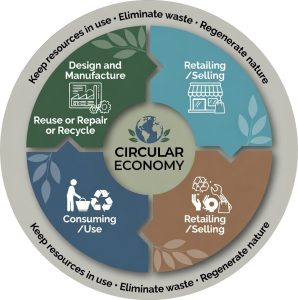
“Finland, along with other countries, outlines that the circular economy provides an alternative for the ‘take, make and waste’ concept. It is about keeping materials in use longer, reducing waste and creating more value from the resources we already have,” added Pajarinen.
Though Finland had become the first country in the world to publish a Circular Economy Roadmap in 2016, Pajarinen noted that several of the ideas are not novel, as various of these ideas had been repurposed to adapt to the circular economy concept.
“For generations, people have repaired products, regenerated materials and continued using them as resources were scarce. In a way, the circular economy concept combines this ancient way of thinking while partnering with modern technological applications,” he expanded.
Pajarinen remarked that the development of a strategy is not enough to affect the required change, but that the cooperation between companies, cities and investors was important to convert the ideas into practical results.
That said, the Finnish government shares that a circular economic concept cannot be implemented by a single actor, but is based on a large scale which includes multiple sectors, industries and aims to be a holistic approach.