




By: Loise Shiimi
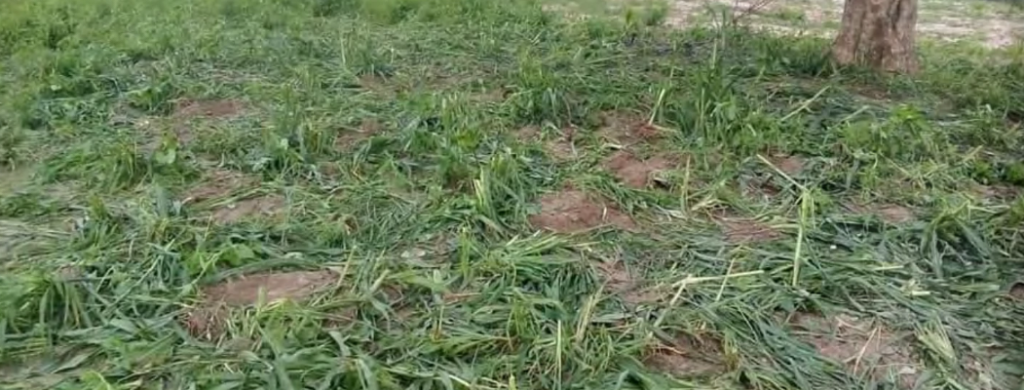
Despite favourable rainfall, which initially led farmers to high expectations for a fruitful harvest this year, these expectations are unlikely to be fulfilled due to elephant-induced damage to their crops.
In an interview with Eagle FM, Andreas Shikongo, a farmer in the Omusati Region, reported that more than 20 elephants had completely destroyed his approximately 2-hectare field.
“This destruction is not limited to pearl millet (Omahangu) crops; it also includes beans, maize, pumpkins, and sorghum. It is disheartening that my field was overgrown and green, but now all vegetation has been destroyed,” he lamented.
He further explained that in previous years, such extensive damage was uncommon, noting that only minor damage had occurred prior to this incident.
Regarding warning signs and mitigation measures, he mentioned that methods such as street lighting and chilli burning are recommended to deter elephants. However, he observed that despite having household lights, elephants still entered the fields.
“I urge the wildlife management authorities or the Ministry of Environment to respond promptly to our plight, as this situation is unacceptable. I had plans to take my family on holiday and enjoy beans and maize, but now I am hesitant to do so, as there is nothing left in my field,” he expressed.
Shikongo confirmed that officials from the Ministry of Environment had recorded his details, and that he awaits a swift response.
Another affected farmer, Mathias Shikongo, expressed similar concerns, noting that his fence had also been destroyed by elephants.
He called on the ministry to provide prompt compensation for the damages, warning that delays could lead to the need for the community to undertake repairs themselves in the absence of investigation or assistance.
He underscored that this is an emergency situation requiring immediate attention. To this, he pointed to the possibility of the elephants returning to instill more fear in his family’s lives. Fortunately, he notes, these elephants have not caused harm to people, only damage to property and crops
Beyond the 2-hectare crop loss, Andreas Shikongo reported that approximately 30 other fields had been affected, and urged the ministry to visit their village to assess the extent of the destruction.
“This issue has persisted since January, and we anticipate that the elephants will leave after the harvest in July, as they typically target cultivated fields during this period,” he added.
Meanwhile, Vilho Hangula, the chief spokesperson of the Ministry of Environment, Forestry and Tourism acknowledged the farmers’ plight and assured that they would be compensated in accordance with existing regulations.
“As a ministry, we apologise for the damage caused by the elephants. We recognise that the elephant population has increased, reaching approximately 25,000, which may contribute to such damage. Compensation policies stipulate that damages involving 0.5 hectares or more are eligible for recompense,” he stated.
Hangula explained that the compensation scheme applies only when damage is inflicted by three or more wildlife animals, such as buffalo, hippopotamus, or elephants. For damages affecting less than 0.5 hectares, the scheme does not provide coverage.
Regarding measures to prevent further conflicts, he revealed that Environment Minister Daniel Indileni has approved the culling of at least one elephant in the affected area to deter elephants from encroaching on human settlements.
“The targeted culling of an elephant aims to frighten others away, and this measure has already been authorised for implementation,” confirmed Hangula.
He urged community members to report such incidents promptly to facilitate timely assistance.