




By: Annakleta Haikera
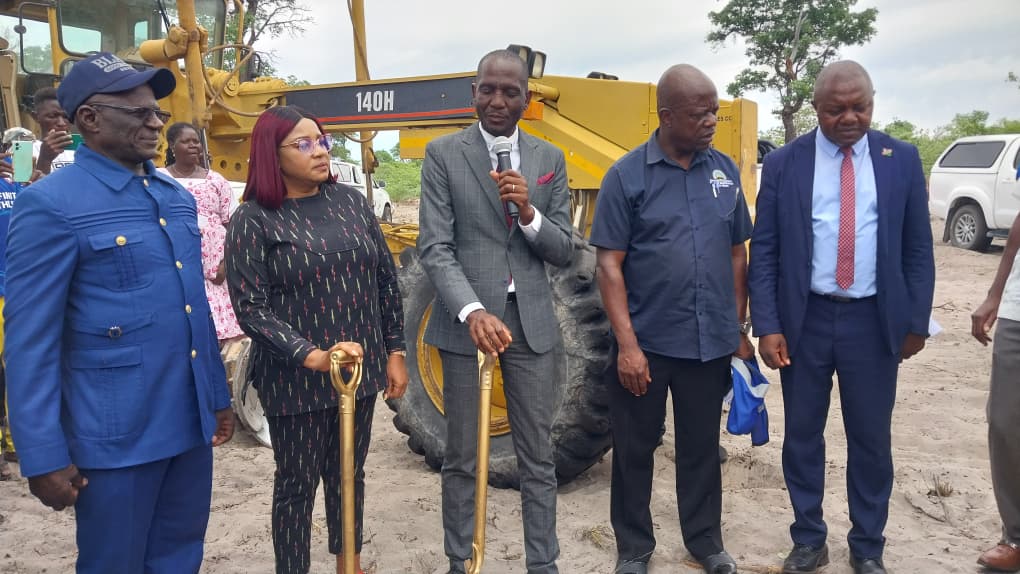
About 80 local residents will be employed during the construction of the long-awaited Mbeyo–Erago road, announced Works and Transport Minister Veikko Nekundi on Tuesday during the groundbreaking ceremony in the Ncamagoro Constituency, Kavango West Region.
However, Nekundi issued a warning to the contractor, stressing that workers must not be exploited “like slaves” and must be registered with the Social Security Commission before they begin work.
Nekundi said the days of workers being underpaid, mistreated, or forced to work without proper safety gear are over.
“Every worker must be treated with dignity. They must receive the correct wages, full protective clothing, and guaranteed social security. These are not suggestions, they are mandatory,” he ordered.
According to information obtained by The Villager, communities along the 20.45km DR3469 stretch between Mbeyo and Erago have dealt with inconveniences for 35 years due to the sand track that becomes impassable during the rainy season.
During the dry months, the sand also makes it hard for vehicles as residents to reach schools, clinics, and markets.
The upgrade, which will use soil stabilisers, is expected to transform mobility and improve access to essential services for five villages: Sihetekera, Senseni, Mutungalika, Kamuti, and Erago.
“Expecting mothers, school children, farmers; everyone will finally move safely and reliably. This road must not only connect villages, it must change lives,” he remarked, adding that the skills gained during construction will benefit young people long after the project ends.
Nekundi also announced that the government has committed funds for the continuation of the Nkurenkuru-Nepara Clinic Road, the Ndiyona-Djaradjara road, and the Divundu-Muhembo Border Post project in Kavango East.
“These developments are part of our national vision to improve access, accelerate economic activity, and uplift rural communities,” he noted.
With the festive season approaching, Nekundi called on all road users to exercise caution.
He also highlighted that he recently launched the 2025/26 Festive Season Road Safety Campaign on behalf of President Netumbo Nandi-Ndaitwah and urged drivers, passengers, and pedestrians to prioritise safety.
Nekundi concluded that the Roads Authority (RA) will oversee the project, while the Roads Contractor Company (RCC) is expected to complete the road within 12 months, and Trinitas Consulting Engineers will supervise and ensure compliance with technical and quality standards.
Meanwhile, RA regional engineering manager, Kennedy Chigumira, used the event to call for urgent investment in rural gravel roads nationwide, saying deteriorating infrastructure continues to isolate communities and hinder access to services.
He highlighted priority routes such as the Charlie Cutline and Ncaute-Karukwisa, and urged motorists to stop overloading, speeding, and vandalising road signs, stressing that communities must help protect public infrastructure.
At the same event, Mbunza Traditional Authority Hompa (Chief) Alfons Kaundu cautioned residents of Ncamagoro not to obstruct or interfere with the construction of the Mbeyo–Erago road by claiming ownership of land or fields along the route. Kaundu said such behaviour would not be tolerated, stressing that the land belongs to the Traditional Authority.
He described the new road as “a long-awaited dream come true” for communities that have had poor accessibility for more than 35 years.
“Our people have suffered enough. Even when we want network towers or shorter routes, nothing can be installed without proper roads,” he said.
The Hompa added that improved roads open the door to essential services, economic opportunities, and regional connectivity.
“Roads lead to development. People will be able to travel from Nkurenkuru through Mbeyo to Grootfontein. This is the progress we want to see,” he indicated.
Residents also expressed contentment about the project.
“We are very happy that this road is finally being built. It will make travelling to clinics, schools, and markets much easier,” said one resident.
Another added, “This road is a dream come true for our community. It will connect us to other towns and improve our daily lives in so many ways.”
Many villages in Kavango West lack usable all-season roads.
According to Kavango West Regional Council reports, remote constituencies are still waiting for basic road infrastructure, which hampers access to essential services.
Because of these infrastructure gaps, remote communities often struggle to transport goods or reach said essential services, especially during rainy seasons when unpaved roads become impassable.