




By: Annakleta Haikera
During the festive season, The Villager visited several subsistence farmers in both the Kavango East and West regions, where mixed reactions were recorded regarding the current rainy season.
Many farmers expressed optimism that the good rainfall would lead to increased harvests, while others raised concerns that heavy rains often came with insects that could destroy their crops.
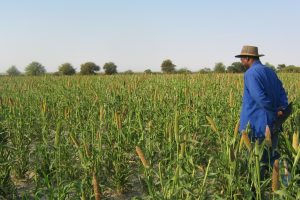
Across several parts of the regions, farmers were observed ploughing and weeding in their fields, with women and children actively involved in sowing seeds.
Some farmers told The Villager that they opted for traditional ploughing using oxen instead of tractors. They cited delays in government tractor services, which reportedly only begin operations in late January or February.
Private tractor services were described as unaffordable, with rates ranging between N$650 and N$800 per hectare in some villages.
Foibe Kanyetu, one of the farmers interviewed, said she decided to cultivate a field located about five kilometres from her homestead because the field near her home was heavily infested with weeds.
“Weeds make it very difficult to hoe. It requires a lot of labour, and hiring people to weed costs between N$30 and N$50 per person, which many of us cannot afford,” she said.
Kanyetu added that rainfall began as early as November, allowing farmers to plant crops such as mahangu (pearl millet), maize, sorghum, pumpkins, watermelons, beans, bambara nuts, and kashana, a short-season variety of mahangu.
When asked about seed sources, farmers said they mainly rely on traditional storage methods, keeping pearl millet in structures made of thatch and mud.
Others said they were forced to buy seeds from the open market after poor rainfall in previous seasons left them without reserves.
Another farmer, Ugongo Markus, said seeds are becoming scarce, but noted that some farmers are making an effort to store small quantities rather than consuming everything after harvest.
“We are also worried about locusts and small ants that are feeding on our crops,” Markus said.
He added that farmers are closely monitoring their fields to prevent insect damage. Despite the challenges, Markus said most of the crops, especially maize and pearl millet, have already started growing well, indicating positive prospects for the season.
Last year, both Kavango East and Kavango West governors encouraged farmers to take advantage of the good rains and plough early, saying the region has the potential to become a food basket due to its fertile and well-watered soil.
The Ministry of Agriculture says government tractors under the ploughing subsidy programme have been operational since 3 November 2025, but high demand and limited resources have caused delays in some areas.
Responding to The Villager, ministry spokesperson Simon Nghipandulwa said the programme operates on a first-come, first-served basis and urged farmers experiencing problems to report to their nearest Agricultural Development Centres (ADCs).
He also shared that diesel shortages experienced in December had been resolved and that tractors were fully operational.
On locust concerns, Nghipandulwa said the ministry has not yet received official reports from Kavango West, but encouraged farmers to report sightings to agricultural offices.
In the Zambezi Region, monitoring teams are already on the ground assessing reported infestations.
Nghipandulwa also clarified that both tractors and animal-drawn ploughs are subsidised at up to 50 percent. In other words, should a private tractor charge N$800 per hectare, the farmer ought only to pay N$400.
With that, he warned tractor owners against overcharging and urged farmers to report misconduct, saying registered service providers are listed at ADCs.