


By: Loise Shiimi
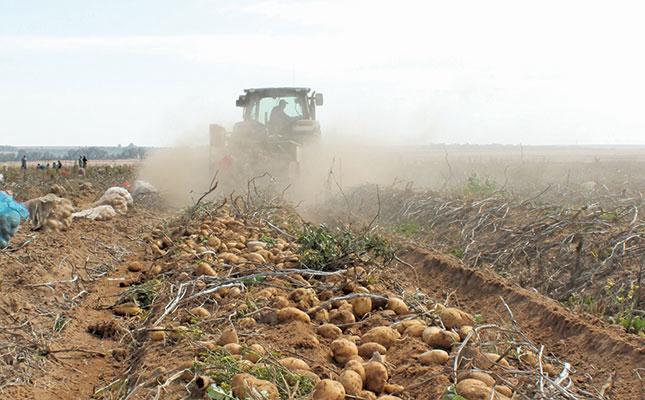
The Etunda irrigation farm is currently in the process of harvesting its potato crop, with expectations of yielding 400 tons.
The farm, under the Etunda Green Scheme, is located in Ruacana approximately 150 km west of Oshakati in the Omusati Region.
In a recent interview with Eagle FM, Sakaria Shilyomunhu, farm manager of the Etunda Green Scheme, reported that they have completed harvesting on 7 of the 22 hectares designated for potatoes. He noted that in the ongoing harvest, the total yield for this year’s crop is projected to reach 400 tons.
Shilyomunhu further clarified that it is not feasible to harvest all 22 hectares in a single day due to the large area and the limited machinery available for the task. Regarding the planting process, he shared that the potatoes were planted at the end of June this year, with 40,000 seedlings planted per hectare.
“Potatoes are not considered a winter crop, as they can be damaged by frost. However, in Etunda, we rarely experience frost, which reassures us that our potatoes are safe,” he stated. He also explained that potato crops thrive in moderate temperatures, avoiding extremes of cold and heat.
Speaking to the nation’s high unemployment rate, Shilyomunhu shared that they have hired approximately 40 temporary workers from the local community to assist with harvesting and packaging of the potatoes. When discussing marketing strategies for the potato crop, he noted that they do not have specific contracts with retailers, stating that they plan to sell to anyone interested, whether for resale or personal use.
Furthermore, with the ongoing importation of potatoes underscoring the low local production, Shilyomunhu pointed out that there is a high demand for potatoes; a crop that cannot be grown year-round due to its need for favourable weather conditions.
“Though we cannot produce them all year long, we typically plant at the beginning of the year for a harvest in mid-year and again around June to harvest in October or November to meet the demand for end-of-year events. For now, we have completed this harvest and expect to plant again only next February or March. However, the demand for potatoes remains constant,” he said.
To farmers interested in cultivating potatoes, Shilyomunhu stressed that potato farming requires significant capital investment, including funds for fertilisers, pesticides to manage pests, and seedlings. However, he affirmed that with the necessary guidance and capital, no crop is too difficult to maintain. He also encouraged emerging farmers to seek advice from experts working with the Namibian Agronomic Board or agricultural officials in their regions.
Potatoes are the number one horticultural products consumed in Namibia, with an annual domestic demand of about 30 000 tons, valued at approximately N$246 million for formal markets. That said, local production only covers about 34% (N$84 million or 8,203 tons) of the annual domestic demand, and 66% (N$162 million or 21,488 tons) is imported mainly from South Africa.
On the other hand, potatoes alone make up 28% of the total value of imported horticultural products, amounting to about N$587 million per annum, and contribute nearly 22% to the total value of locally produced horticultural products, at about N$388 million per annum.
In 2012, potatoes were introduced as a Special Controlled Product under the Special Controlled Products Scheme (SCPS).
President Netumbo Nandi-Ndaitwah, during the launch of the sixth National Development Plan (NDP 6), urged Namibians to add value to their products. She stated that enhancing local production would create more opportunities, consequently reducing unemployment.
When asked about how the Etunda Green Scheme adds value to its products, Shilyomunhu mentioned that they currently process maize meal. In addition, he stated that plans are underway to establish a processing centre for juicing mangoes, as they also manage a large mango orchard.
Moreover, Shilyomunhu revealed that they have recently planted 450 hectares of maize, primarily for maize production as a means to contribute to the nation’s food security.
“This maize crop will take about six months to dry, after which we will process it into maize meal for sale to private dealers and individuals, as well as store it in silos,” he explained.