





By: Nghiinomenwa-vali Hangala
In the midst of regulatory and compliance issues between the Ministry of Transport and the e-hailing sector, urban dwellers want the sector to expand because of its convenience.
Urban mobility in various towns in Namibia has been dominated by numbered taxis, however, for the past 3 years, a new branch of transportation called e-hailing has entered the market.
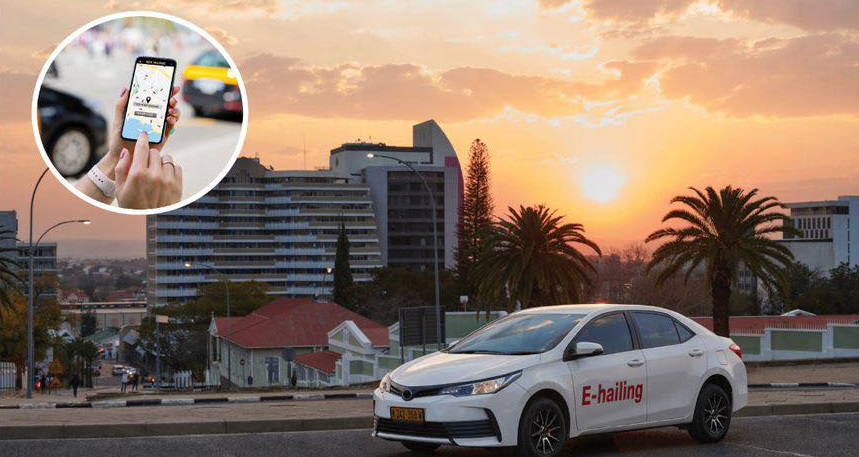
E-hailing is defined by the Transport Ministry as app-based services (inDrive, Lefa, Yango, and Yene) providing convenient booking, dynamic pricing, and generally faster service in cities, particularly during peak times.
They offer a different approach to urban mobility (point A to B transportation services).
The sub-sector has, however, recently faced regulatory scrutiny and compliance ultimatums, threatening its sustainability.
The Villager spoke to various youthful labourers active in Windhoek on the importance and significance of the e-hailing subsector.
Chartered accountant Sofia Kambungu indicated that the sub-sector must actually expand because it is more convenient, but the fee structure should be re-examined, especially during peak hours.
“Their prices must be regulated; they take advantage of rush hours and rainy seasons when they know demand is very high,” she stated.
Jona Musheko, communications officer in the energy sector, hailed the e-subsector as innovative, also speaking to its convenience.
“It’s an innovative idea that serves clients better. It creates convenience. Imagine myself hopping into a normal taxi with three other clients going to different locations; we should move from those old ways of customer satisfaction,” he said.
On the regulatory and compliance scuffles, Musheko said the law must rather find ways to accommodate these platforms, not punish or cut them out.
“Let the innovation expand, the law must be amended to serve the people. We have family members who can’t get jobs in this tough economy, and now they depend on operating these e-hailing vehicles,” he stated.
Musheko advised lawmakers to be more innovation-oriented by keeping up with new sectoral trends in technology to serve the people.
“We voted them to serve us and make pragmatic laws that enable and propel our society,” he reminded.
Musheko added that competition must be maintained in every sector, noting that maintaining models and approaches that are not serving current needs is not progress.
“The current set of taxis is not conducive. Even those imposing public members to use them hardly do so because of their conditions,” observed Musheko.
Economic observer Abraham Iita explained that the entry of e-hailing platforms like Yango, Lefa, City Cab, and inDrive has improved urban mobility by reducing transaction costs and matching supply with demand more efficiently.
He said it has enhanced productivity by saving time and increasing reliability in transport, especially taking into account that the Windhoek system is fragmented.
The provision of this e-hailing service fills critical coordination gaps, noted Iita.
Regarding value, Iita said the income-generating ability for the youth and innovation component is worth expanding.
“When you factor in that nearly over 60% of youths are unemployed in Namibia, and the need for innovative business, it is a positive development as it creates income opportunities at lower barriers to entry for employment,” he explained.
He added that the platform has reduced the social cost of crime, suicide, and depression among youth because they can use their family members’ vehicles to earn.
“From a business perspective, it has also allowed car owners to monetise their assets flexibly,” indicated Iita.
He highlighted that the e-hailing platform’s income-generating ability adds to unemployment reduction efforts, complementing other formal job creation efforts as there are currently limited social protections and platforms to earn.
On the regulatory scuffles, Iita indicated that stopping e-hailing would reduce competition and harm consumer welfare.
“The better approach here is to accommodate them through updated, adaptive regulation, especially considering this is an autonomous system. This should ensure safety, fairness, and taxation without stifling innovation,” he recommended.
Iita stated that regulators need to move from reactive to proactive and implement flexible frameworks that can adapt to innovation.
He said most of Namibia’s laws remain outdated and do not necessarily speak to the evolving landscape, sharing that there is a need to review this policy to ensure participation and reduce barriers for innovators.
He also stated that tools like regulatory sandboxes and stakeholder engagements are essential for institutions such as NaTIS, the Ministry of Works and Transport, and the City of Windhoek to test innovative ideas.
Moreover, Iita advised that the country enhances its investment in building institutional capacity to understand digital platforms, which is key to staying competitive – a function to be undertaken by the ICT regulator CRAN.
Economist Achiles Shifidi said e-hailing is becoming very important for urban areas in that through the city’s expansion, public transportation is becoming limited and many rely on shared taxis or private cars.
“E-hailing improves reliability and convenience as drivers are registered and prices and routes are known well in advance,” he said.
The sector has a shorter waiting period and better matching of supply and demand, further improving efficiency.
On the platform’s ability to generate income, Shifidi also highlighted Namibia’s high unemployment rate, especially among young people.
“E-hailing thus provides immediate income opportunities for young people, and they become economically active,” he noted.
Shifidi, however, flagged that employment through e-hailing is not secure, and the costs involved are high, such as fuel and maintenance fees.
On the regulatory approach, he recommended that Namibia accommodates e-hailing, saying that “much of the country’s transport registration frameworks are old and inherited from the pre-independence era. If e-hailing is stopped, it will push it underground, which will be difficult to regulate, and will reduce income-generating opportunities.”
He said that observation across regulators reveals a slow response to innovation.
“The process of changing, appealing, and formulating new laws is moving at a slower pace than technological regulation. As a result, new sectors are seen as threats instead of opportunities,” observed Shifidi.
Climate and geoscience student Ndishishi Ipinge noted that e-hailing platforms should not be shut down because of the value they create within urban mobility.
“In a city like Windhoek, especially in areas such as Katutura, the population and transport situation demands alternatives. Standing by the roadside for hours waiting for a taxi is not only frustrating, but impractical for professionals rushing into town,” explained Ipinge.
She added that e-hailing services, by contrast, are timely, reliable, and private, offering passengers the privacy of travelling without strangers.
She explained that “From a climate scientist’s lens, I acknowledge the tension: public transport remains the recommended sustainable option for reducing emissions and congestion. Yet, the lived reality of urban commuters requires flexible solutions. E-hailing fills that gap, balancing affordability with accessibility.”
Financial officer, Magano Fudeni, commented that she finds e-hailing to be a more convenient and sometimes cheaper method of daily transportation.
“It has been a safer option as well,” she said.
According to Fudeni, the demand and supply are balanced at the moment. However, navigation systems and other administrative issues drivers experience could be improved on.
Also commenting on price hikes during peak hours, she stated that “Their prices can be unhinged at peak times, also at night, so maybe the regulator can assess and guide.”
Fudeni noted that fare setting must be transparent to ensure fairness as the e-hailing services’ prices often fluctuate, sometimes even influenced by weather conditions, which calls for government monitoring.
“Regulation is not about suffocating innovation; it is about protecting consumers and ensuring equity,” she said.
Moreover, Ipinge encouraged e-hailing operators to legalise their operations by securing permits, paying the required fees, and obtaining the necessary documentation like other transport providers.
“Imagine how taxis are being forced to provide all the documents at the road block; what do the e-hailing drivers prove? Only then can they stand as legitimate players in Namibia’s transport ecosystem,” she stated.