

By: Dwight Links
Namibia appointed its third National Governing Council for the African Peer Review Mechanism (APRM) in a national ceremony at State House on Monday.
President Netumbo Nandi-Ndaitwah met with the new members of the council during the ceremony, which swore in: Wilfried Emvula (former ambassador) as chairperson, Elia Kaiyamo (former ambassador), Betty Schröder, Esau Kaakunga, Roseta Nawases, Naita Hishoono, Rosemary Nalisa, Uhuru Dempers, Hakusembe Hakusembe, and Salomo Hei.
The APRM is an AU mechanism that has voluntary participation by member nations aiding in self-monitoring and promoting good governance and development.
President Nandi-Ndaitwah outlined that having joined in 2017, the country shares the common goals of transparency and accountability.
“Namibia’s accession to the APRM demonstrates our commitment to transparency and accountability both at the national and continental levels. The APRM provides us with an opportunity to review our processes, systems, and institutions to identify areas of improvement and achievements,” explained the President.
According to her, the country signed the memorandum of understanding to institute its own mechanism for monitoring developmental progress, as Article 19 of the APRM Statute (2020) dictates that ‘Namibia has to establish a National Governing Council to provide strategic oversight and ensure transparency, credibility, and ownership of the APRM process.’
“Therefore, today’s inauguration of the Third National Governing Council of the APRM reaffirms Namibia’s commitment to strengthening the governance architecture as outlined in the sixth National Development Plan (NDP 6) and contributing to Africa’s Agenda 2063,” said Nandi-Ndaitwah.
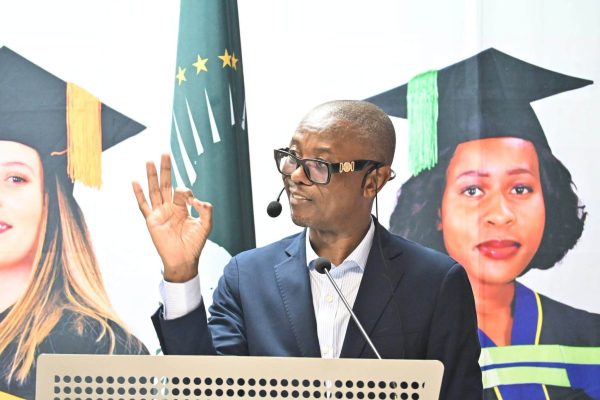
Incoming chairperson of the council, Wilfried Emvula, outlined that the council aims to provide guidance in line with national projects.
“We are entrusted with providing strategic policy guidance and oversight on the implementation of the Mechanism in the country. Our task remains the timely undertaking of the Review Reports and ensuring the effective implementation of the National Programmes of Action and other key governance components, which include monitoring Agendas 2030 and 2063,” Emvula expanded.
Tasks Outlined
Addressing the President and Prime Minister, Emvula shared that there are four main tasks ahead of the council.
According to him, the council has to develop the Progress Report on the implementation of the first-generation Country Review Report on the National Programme of Action.
“This is expected to be presented by Your Excellency [Nandi-Ndaitwah], at the 36th African Peer Review Forum of Heads of State and Government in February 2027,” Emvula shared on the timeframe they have to work under.
The second goal also pertains to developing another report and its implementation framework.
“We have to support the development of the Second-Generation Country Review Report and its National Programme of Action for implementation,” the chairperson explained.
Emvula also indicated that the council would continue monitoring the implementation of the National Programme of Action of the Targeted Review Report on Youth Unemployment of 2019 and produce a progress report.
The last goal would be to mainstream the mechanism at the sub-national levels to strengthen participatory governance.
Impact So Far
Since joining the APRM, Namibia has completed two review reports, namely the Targeted Review Report on Youth Unemployment (2019) and the Country Review Report (2021).
Earlier this year at the 35th APRM Forum of Heads of State and Government in Ethiopia, President Nandi-Ndaitwah presented Namibia’s First Progress Report on the implementation of the National Programme of Action on Youth Unemployment.
According to the presidency, the report highlighted interventions such as the establishment of the Sovereign Wealth Fund and the National Youth Development Fund.
The council stated that they have a mandate to advance the APRM’s six thematic areas, which include Democracy and Political Governance; Economic Governance and Management; Socio-Economic Development; Corporate Governance; State Resilience to Shocks and Disasters; and E-Governance.
The Presidency underscored the importance of context-driven development and urged the council to pursue reforms that respond to Namibia’s realities, while meaningfully contributing to Africa’s broader development agenda.