




Photo: Contributed
By: Nghiinomenwa-vali Hangala
According to the Livestock and Livestock Products Board of Namibia, 2,2 million birds were slaughtered, compared with 1,764,841 birds in September 2025; a 23.48% increase. The figure represents the highest monthly total recorded in the 2025–2026 period.
Compared with August 2026 (1,98 million), marketing rose by 9.62%.
All birds were slaughtered at B&C class abattoirs, with no live exports recorded during the month, the Board revealed.
Year-to-date marketing reached 17.88 million birds, 24.47% more than in January–September 2025 (14.4 million birds).
The Livestock and Livestock Products Board of Namibia (LLPBN) has also noted that local poultry product production increased by 4.75% m/m to approximately 3.83 million kg in September 2026, from 3.65 million kg in August.
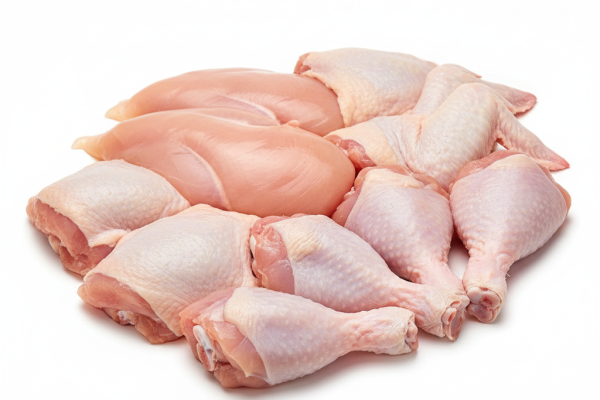
Other chicken cuts, including IQF and 9-piece cuts, remained the largest category at 2.39 million kg, accounting for 62.40% of production.
The monthly increase came mainly from breasts (+35.25% to 280,423 kg), thighs (+33.13% to 228,942 kg), drumsticks (+28.82% to 214,113 kg) and wings (+8.62% to 133,822 kg), while no other boneless cuts were recorded, compared with 15,080 kg in August.
Offal production, which is not reported separately, is estimated at 280,446 kg based on July production.
Production is forecast at approximately 3.78 million kg in October 2026, 1.16% below September.
In terms of company contribution, NPI accounted for 71.42% (1,6 million birds) of September slaughter, followed by Maranatha Abattoir (325,450 birds, 14.93%), KADILA (229,203 birds, 10.52%) and Hochland Farms (61,953 birds, 2.84%).
Year to date, 17,877,799 birds were marketed, 24.47% more than in January–September 2025 (14,363,502 birds).
Maranatha Abattoir, which did not slaughter in 2025, contributed 2,083,347 birds, equal to 59.28% of the year-to-date increase. Excluding Maranatha, marketing was 9.96% higher than in 2025.
The Board has, however, flagged feed costs, highlighting that poultry feed ingredient prices increased for a third consecutive month in September 2026.
Soybean prices rose by 8.75% m/m to N$8,823.95/t and were 22.49% higher than in September 2025, while yellow maize rose by 8.88% to N$3,990.15/t, 10.93% above September 2025 and the first year-on-year increase since July 2025.
Since June 2026, soybean and maize prices have increased by 30.75% and 25.74%, respectively, reversing the generally declining trend recorded during 2025 and the first half of 2026, according to LLPBN.
“As maize and soybeans are the main ingredients in poultry feed, sustained increases are likely to raise production costs for poultry and egg producers,” the Board cautioned.
To date, poultry and poultry product imports declined by 5.4%, from 15,9 million kg in January–September 2025 to 15,1 million kg in 2026, consistent with the growth in domestic chicken production.
South Africa remained the main supplier (48.2% of imports), followed by Poland (23.4%), Argentina (10.9%) and Brazil (9.2%).
In September, poultry imports declined by 22.74% m/m to 1,887,768 kg and were 1.21% lower than in September 2025
Mechanically deboned meat (MDM) accounted for 76.36% of September imports, the Board revealed.
erastus@thevillager.com.na