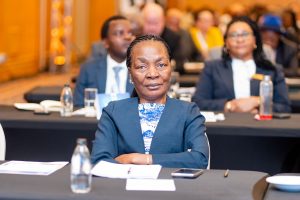
Photo: MICT
By: Nghiinomenwanwa-vali Hangala
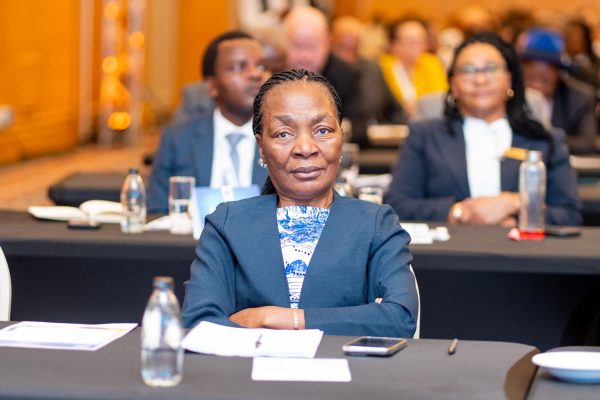
Namibia’s treasurer, Ericah Shafudah, has revealed that the Ministry of Finance received requests from Offices, Ministries and Agencies (OMAs) for additional funding totaling N$13.1 billion for consideration during the Mid-Year Budget Review.
However, the national budget for the year was only increased by N$700 million from N$87.9 billion to N$88.6 billion, representing a modest upward adjustment in comparison to what the OMAs requested.
Moreover, only 53% of the tabled budget has been spent thus far.
According to Shafudah, the FY2026/27 mid-year budget was prepared against “slower-than-expected economic growth, a downward revision of revenue by N$1.5 billion, rising debt servicing costs, and additional funding requests by Offices, Ministries and Agencies of N$13.1 billion.”
She stated that the Mid-Year Budget Review process provides the government with an opportunity to improve the effectiveness of resource allocation by taking stock of the implementation of the national budget thus far.
Moreover, it allows the government to make adjustments and ensure that it remains on course to achieve its planned development priorities.
The biggest beneficiary of the review is the Ministry of Finance, which was allocated an additional amount of N$665 million, comprising N$535 million to address funding requirements for PSEMAS and N$130 million to replenish the Contingency Fund.
Second was Defence, which has been allocated an amount of N$200 million, comprising N$100 million for rations and N$100 million for utilities.
Third is the Office of the President, which has received an additional N$180 million, with N$140 million earmarked for the construction of basic sports facilities under the coordination and supervision of regional governors.
This allocation, according to Shafudah, has necessitated the transfer of the budget allocation to Vote 01 from Vote 27: Sport, Youth and National Service to ensure streamlined implementation, enhanced accountability, and expedited delivery.
As at 30 September 2026, expenditure commitments and actual spending amounted to N$47.0 billion against a total appropriation of N$87.9 billion, translating into an overall budget execution rate of 53.5%, Shafudah revealed.
The development budget expenditure, including commitments recorded, reached an execution rate of 42% at mid-year, while operational expenditure reached 53%, reflecting steady implementation of approved programmes and activities.
However, local entrepreneurs and contractors are questioning where the money went or who was contracted.
According to Shafudah, to strengthen the implementation of preferential procurement, the government issued a directive clarifying the application of the Code of Good Practice on Preference.
Adding that the directive is yielding positive results, with MSMEs accounting for 53% of reported procurement awards in the first quarter of FY2026/27, securing contracts valued at N$246.4 million.
In February 2026, the Ministry of Finance tabled before the August House a budget totaling N$87.9 billion for FY2026/27, comprising N$81.4 billion for operational expenditure and N$6.6 billion for development expenditure financed through the State Revenue Fund.
In addition, N$8.9 billion was allocated to development projects financed outside the State Revenue Fund, bringing the total development budget to N$15.4 billion.
Consequently, total expenditure, including statutory commitments, amounted to N$106.0 billion, of which N$16.2 billion was earmarked for statutory commitments.
According to the treasurer, the revised fiscal outlook for FY2026/27 is that total expenditure, including statutory commitments, was revised down to N$105.0 billion.
Non-interest expenditure is at N$89.6 billion (including loan-funded projects), and interest payments are projected at N$15.4 billion, equivalent to 17.5% of total revenue.
The budget deficit is estimated at N$16.3 billion, or 5.5% of GDP, while the primary deficit is projected at 0.3% of GDP.
Total public debt is projected at N$201.7 billion, equivalent to 68.7% of GDP, while government guarantees are estimated at N$11.8 billion, or 4% of GDP.
erastus@thevillager.com.na