



By: Peneyambeko Jonas
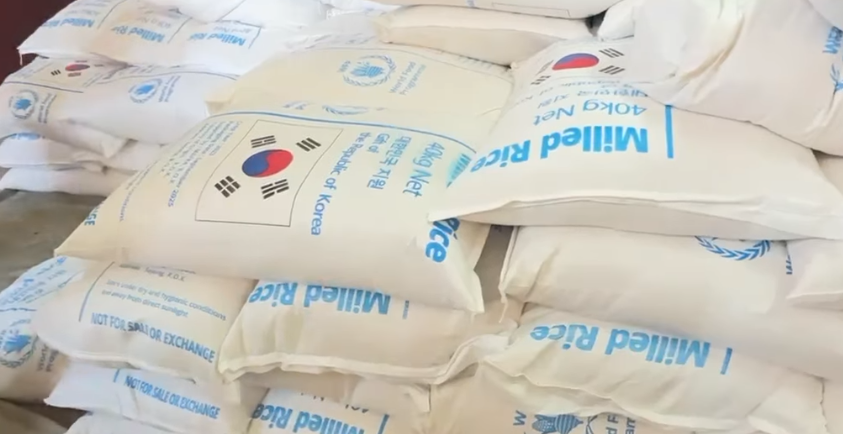
The ongoing distribution of South Korea’s donated rice to the Namibian government has sparked public discussion, following the circulation of reports on the distribution in Oniipa Constituency, Oshikoto Region on Monday, 18 May 2026.
The reports have prompted queries and debates on whether Namibia still faces drought, and why the country continues to receive food donations despite improved rainfall in recent seasons.
The rice donation traces back to the drought experienced in 2024, when President Nangolo Mbumba declared it a national emergency and appealed for international food assistance.
South Korea was among the countries offering said aid, donating rice to support drought-affected communities across the country.
Oshikoto Regional Council spokesperson, Petrus Nehale, told Eagle Media House that the current rice distribution does not mean the region is presently experiencing a drought crisis.
“It’s not like Oshikoto Region is currently facing drought. With the rice donation received from South Korea as drought relief, they are just responding to what happened in 2024,” Nehale clarified.
He explained that the regional council is distributing the donation as part of the government’s continued response to affected households which remain economically vulnerable.
According to Nehale, the council has prioritised low-income households in identifying beneficiaries.
“There are households where people are earning very little. The only time they eat rice is during special occasions such as Christmas, New Year celebrations or weddings, so they are among the first intended beneficiaries of this rice donation,” he said.
Nehale added that beyond poverty-related considerations, the council also uses part of the donated food to assist residents facing emergencies.
“As donations like these come in, we also consider emergency assistance in the community, such as households whose homes were damaged by fire or destroyed by heavy winds,” he shared.
Residents in rural communities say while rainfall has improved compared to the drought years, several households continue to face food insecurity due to poor crop yields and difficult farming conditions.
Elizabeth Amakali, a resident of Elago Village in Omuntele Constituency, said the assumption that good rainfall automatically guarantees food security does not reflect the reality faced by many villagers.
“For the past two years, people would say we received good rain and no one will starve this year, but even heavy rain comes with negative effects,” said Amakali.
“With our soil, too much water causes our mahangu crops to struggle because the soil is sandy and infertile. Therefore, we are still grateful to receive this rice donation to feed our children,” she added.
Traditional leader Johannes Amutenya, Elago Village headman, said his community still experiences food shortages despite recent rainfall.
He explained that the village has 66 registered households, but only 60 received the 5 kilogram (kg) rice donation, leaving six households without assistance.
“That is still an indication that we are starving as a community. The need is still there, and some families remain vulnerable,” stated Amutenya.
The rice donation has also reignited debate about the need for Namibia to strengthen local food production to reduce reliance on foreign aid.
Vaino Namushinga, a rice farmer from Onayena Constituency in Oshikoto, believes the country has the potential to produce its own rice if government invests in local farmers.
“If the government could invest in rice production, then I don’t think we will need rice as a drought relief from other countries,” noted Namushinga.
He stressed that the region has suitable areas for irrigation-based rice farming and enough trained farmers to support commercial production.
“Oshikoto is very big. There should be rivers or local water swamps that the government can develop into rice farming areas. We are more than enough trained farmers in Oshikoto, and if government invests in rice production, we will be able to produce enough rice at commercial level that will benefit our nation,” he remarked.
Namushinga said many local farmers already have the technical knowledge to grow rice, but lack the infrastructure and resources needed to expand production.
“Right now we have knowledge, but we lack water, technical equipment and support. If maybe the government could assist with water tanks, boreholes and invest in rice production, then we will have enough. Even if Namibia experiences drought in years to come, we will be ready,” he mentioned.
While the rice donation has brought relief to many households, the mixed reactions from residents highlight a broader concern around long-term food security and climate resilience in Namibia.
While several in Oshikoto may welcome the assistance, it also raises questions about whether more sustainable local agricultural investment could help communities withstand future droughts without depending on external aid.