
By: Dwight Links
The 52nd session Universal Periodic Review (UPR) Working Group was recently held by the UN Human Rights Council in Geneva, Switzerland. During the session, a Namibian delegation reported on the country’s human rights interventions and improvements since independence.
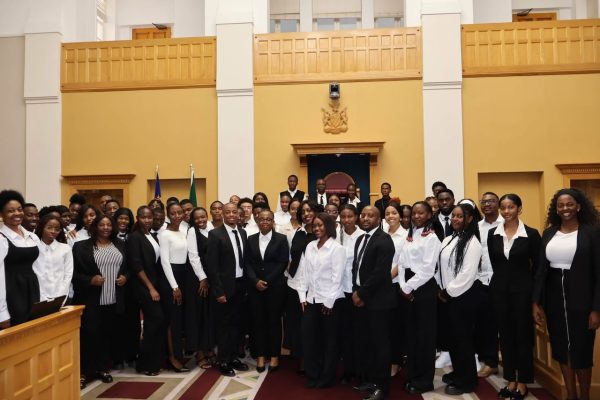
The delegation of nine experts was led by Justice and Labour Minister Wise Emmanuel.
This reporting session examined the implementation of recommendations made during a 2021 assessment. These included the promotion and protection of human rights on the ground.
PROMOTING AND PROTECTING HUMAN RIGHTS
Namibia reported that it included a ‘National Plan of Action on Gender-Based Violence,’ which mainly focuses on the victims and survivors of said violence.
“[The plan]places survivors first and stimulates a culture of care amongst families, communities and institutions, which promotes early help-seeking behaviours,” shared the delegation.
This plan is tied to Sustainable Development Goals (SDGs) 3, 4, 5, 10 and 16 which reflect Good Health & Well-being, Quality Education, Gender Equality, Reduced Inequalities and Peace, Justice & Strong Institutions.
The delegation outlined that the gender-based violence (GBV) interventions on the ground were installed for direct action to cases of violence countrywide.
Another recommendation tied to SDGs 5 and 16 highlights that Namibia’s government will consider whether to grant a request to “special procedure mandate holders of the Human Rights Council.”
These are independent human rights experts with mandates to report and advise on human rights from a thematic or country-specific perspective.
The Council describes these experts as representing a system “with special procedures that is a central element of the United Nations human rights machinery and covers all rights: civil, cultural, economic, political, and social.”
On another recommendation zeroing in on SDGs 3, 5, 10, 16 and 17 – with 17 being Partnerships for Goals – the Namibian delegation cited Cabinet’s 2024 directive to review the National Human Rights Action Plan (NHRAP).
This plan ran from 2015 to 2019, with another expected to take shape in efforts to meet the SDGs.
“The government should develop a successor plan. Namibia will continue with its efforts to fulfil its international obligations by developing and implementing comprehensive national plans and programmes,” explained the delegation.
This was coupled with the indication that other programmes are linked to this approach, such as the welfare of children.
“Namibia continues to implement its national programme for children and its harmonisation with other strategies, such as the national strategic framework for the fight against HIV/AIDS and the gender equality and child welfare framework,” the report outlined.
According to the presentation, the nation also established the Inter-Ministerial Committee on Human Rights (IMC).
“The IMC is a standing coordinating committee for implementation and reporting. The IMC has been in existence since 2002,” indicated the delegation.
BUDGETING FOR NEEDS
Two recommendations from the report outlined that Namibia also supports civil society organisations in partaking in national projects and agendas of a harmonised society.
According to the report, the civil society are also members of the IMC and are consulted when reports are prepared for submission to the Universal Periodic Review Working Group, treaty bodies, and the African Union.
The Human Rights Council held a meeting with civil society organisations on 24 November 2025 to discuss this report.
In the report, the Namibian government provided financial resources to the relevant ministries to tackle GBV.
“The budget of the Ministry of Gender Equality and Child Welfare was increased by 23.2% to N$8 billion in the financial year 2024/2025. The budget includes N$824.7 million to maintain the real value of the social safety nets,” the report states.
In this same period, the government also increased the frequency of food distribution to marginalised communities at a cost of N$170 million, and N$284.5 million to ensure full coverage of the Orphan and Vulnerable Children Grant.
DEVELOPMENTS SINCE 2021
During the period under review, Namibia co-facilitated the Summit of the Future; participated in the Human Rights 75 High Level Event; participated in the case of Obligations of States in Respect of Climate Change; and hosted the 25th Anniversary of the United Nations Security Council Resolution 1325 on Women, Peace and Security.
Namibia is still reviewing the National Plan of Action on Women Peace and Security 2019-2024 and the National Gender Equality and Equity Policy for 2025-2035.