

Photo: Ndamanguluka Nakashole
By: Ndamanguluka Nakashole
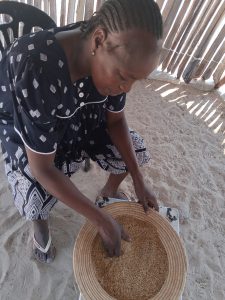
Sesilia Silas, a 44-year-old pearl millet farmer in Namibia’s Ohangwena region, remembers a time when farming felt more certain. Farmers, she says, knew exactly when to plough, when to plant and when to harvest. Today, however, that confidence is gone.
“Nowadays, we have to keep guessing. We just have to hope for the best,” says Silas, citing erratic rainfall patterns that are forcing local people to change how they farm.
She and her husband keep goats, and the manure from their kraal is used on the pearl millet farm.
Her goats provide manure. The manure helps the soil. The soil supports the mahangu. The mahangu feeds her household. It is a simple cycle, but one that can matter greatly to a family living from one harvest to the next.
She has also changed the type of pearl millet, known locally as mahangu, she plants.
Silas has turned to a variety known locally as okalya, which is said to cope better with unpredictable weather patterns than the traditional one.
When the rain can no longer be trusted
Dr Teofilus Shiimi, a senior lecturer of agricultural economics at the Namibia University of Science and Technology (NUST), says climate variability is affecting mahangu production through increasingly unpredictable rainfall. The rainy season can now be short, he says, with rain sometimes stopping before the crop has matured.
This can leave farmers with poorly formed heads and underdeveloped grains, resulting in poor harvests. In more severe cases, the rain can stop before mahangu begins to flower. While conducting his PhD research titled “ Conservation Agriculture: Analysing Willingness to Adopt, Crop Productivity, and the Effects of Socioeconomic Factors in Northern Namibia” in the northeastern regions of Namibia in 2019, Dr Shiimi observed that rain stopped completely before crops reached the flowering stage.
Although the crops had initially germinated well, they eventually withered, leaving farmers with nothing to harvest.
He says improved and early maturing seed varieties can help provide a stronger buffer against diseases, pests and dry spells while research can also help develop better varieties.
This is important because some farmers have concerns about certain improved varieties. Okashana No. 2, for example, can produce good yields and mature early, but some farmers do not prefer it because the grain does not develop as well and can produce dark or black flour.
Women adapting with what’s at hand
Silas’ relative success applying goat manure on her pearl millet field and making the small kraal part of her farming system shows that adaptation does not always come in the form of expensive technology.
Dr Axel Rothauge, an agricultural specialist, says improving soil health is increasingly important in northern Namibia where soils are mostly sandy and lose water and nutrients fast. He recommends improvement of the amount of organic matter in the soil and exploring the use of biochar to enhance soil’s moisture and nutrients retention.
The is important because farmers cannot control rain patterns, but they can change conditions of the soil that receives the rain.
From farmer to trader
Not every woman can continue farming. At the Ondangwa open market in Oshana Region, 59-year-old Toini Iyepa has found another way to remain part of the mahangu food system. Iyepa used to farm on the local government land before she was evicted. She spent the little compensation she received to build her new house.
“I had a field,” she says. “Now I can no longer farm, so I go to those with fields, collect mahangu sometimes on credit, and sell, then pay back.”
She buys a 20 litre bucket of the mahangu for N$100 ($6.04) and sells it for N$110 ($6.61).
Iyepa may no longer be able to produce the grain, but she remains part of the food system by connecting producers and consumers of mahangu for some income. Lydia Hangula, on the other hand, took a different route; she buys mahangu, pounds it and sells the flour.
The women are active at different points of the same food chain, helping keep food moving through rural and urban communities.
Hidden cost of being a woman farmer
But the gender side of climate adaptation cannot be ignored. Dr Shiimi says rural women often carry responsibility for households and children, which can make it difficult for them to travel to find improved seed, attend agricultural training or access markets. This means that simply making training available does not guarantee that women will benefit from it.
If a training session is far away, who looks after the children? If improved seeds are available in another town, who pays for the trip? If machinery is introduced but requires money to access, who can afford it? These questions matter.
A 2026 review published by researchers linked to the International Food Policy Research Institute and the International Center for Agricultural Research in the Dry Areas found that improving women’s climate resilience requires better access to agricultural resources, knowledge, skills and economic opportunities.
The review also warns that policies can exist without producing meaningful change.
Investing in women to strengthen food systems
Experts say supporting women to adapt to climate change requires more than improved seeds and farming techniques. Women also need access to training, finance, technology and markets to strengthen their livelihoods.A 2026 report launched on 15 October by the CGIAR GENDER Accelerator, Advancing Equality, Transforming Futures: A Path to Resilient and Productive Food, Land and Water Systems in 2050, identifies unequal access to resources and the burden of unpaid care work as barriers facing women, particularly young women.
It recommends creating better employment opportunities, including in food processing, marketing and retail, while ensuring women can participate in decisions affecting their livelihoods. In northern Namibia, women such as Iyepa, who trades in mahangu, and Hangula, who processes the grain into flour, already earn income beyond farming. Improving access to processing equipment, business training, finance and reliable markets could help women strengthen these livelihoods and reduce their dependence on harvests alone.
The report’s findings come as climate change adds pressure to food systems worldwide. In a press release issued on 15 October, CGIAR Executive Managing Director Ismahane Elouafi warned that decisions made today would shape the future of food, land and water systems.
“The choices we make over the coming years will determine whether food, land, and water systems become more equitable or more unequal, more resilient or more fragile,” Elouafi is quoted saying in the press release.
Nicoline de Haan, director of the CGIAR GENDER Accelerator, said: “Investing in women, not as laborers, but as leaders, is the path towards unlocking the full potential of our food, land and water systems.”
A national crop and opportunity
In May, Namibia launched a UN Food and Agriculture Organization-supported project aimed at improving the productivity and value chain of pearl millet under the One Country One Priority Product initiative. The $250,000 project will run until August 2027, and aims to support certified seed production, train more than 800 seed growers, strengthen climate smart farming and improve coordination between farmers, millers, agro-processors, cooperatives and research institutions.
The International Year of the Woman Farmer offers Namibia a chance to look again at these women, not as an afterthought in the agricultural system, but as farmers, food producers, traders, knowledge holders and problem solvers whose work is already helping families and communities adapt.
*This story was produced with support from MESHA.