


By: Dwight Links
The International Renewable Energy Agency (IRENA) views Namibia as the prime example of a fast-moving market that has placed emphasis on renewable energy adoption.
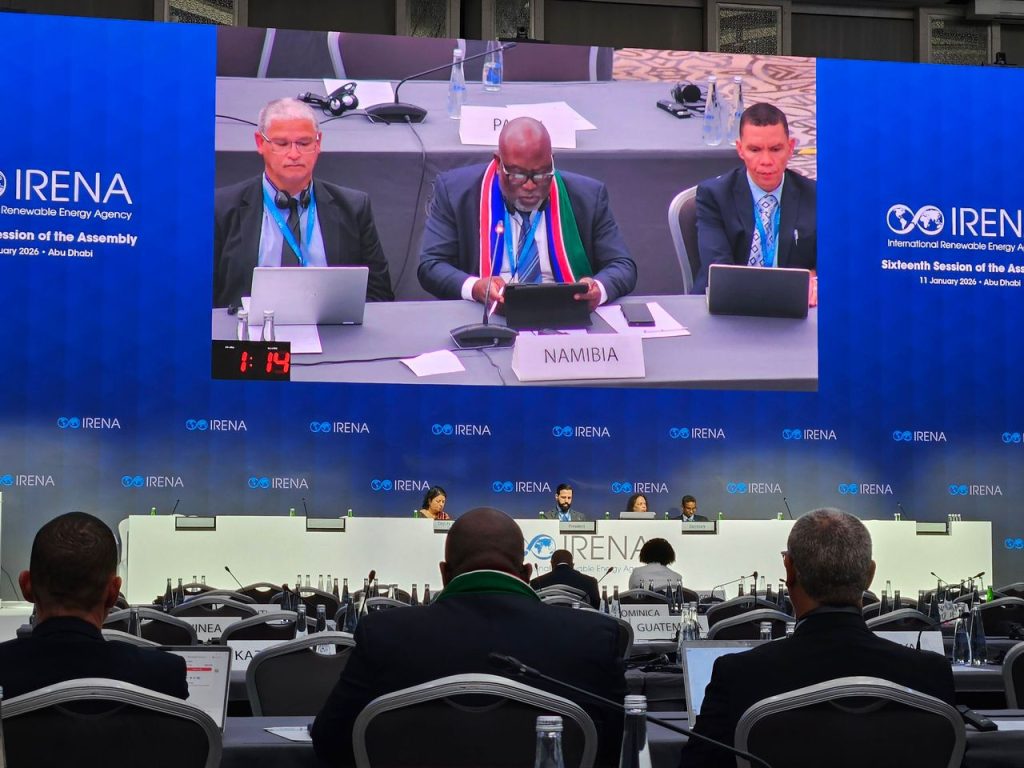
These sentiments were shared at the recent IRENA 16th Assembly that took place in Abu Dhabi, United Arab Emirates.
According to the agency, Namibia is a country with a clear strategy, a strong political backing, coupled with emerging green hydrogen leadership.
IRENA director-general, Francesco La Camera, highlighted that the trend to a just energy transition is unstoppable.
“The energy transition is unstoppable, and nothing can reverse it. It is time for countries to reinforce their renewable energy strategies, not only for climate action, but because renewables are the most resilient and no-regret economic pathway for development, security, decarbonisation, and competitiveness,” La Camera noted.
He explained that the competitiveness of tomorrow’s economies will be largely determined by their ability to move electrons and molecules at the lowest possible cost, and to deliver clean, safe, and affordable energy services.
Also noting that “fast movers will gain lasting productivity and competitive advantages over those who hesitate.”
Fillemon Katamelo, Deputy Speaker of the National Assembly, represented the country at the Legislators and Regulators Forum platform of the IRENA assembly.
Katamelo noted that the country’s approach to the Just Transition is based on strategic clarity, anchored on political grounding and decisiveness. He explained that the government signalled early on that green hydrogen is a national economic pillar embedded within Vision 2030, the Fifth National Development Plan, and Namibia’s updated climate commitments.
“This alignment across planning, energy, and industrial policy reduced policy uncertainty and gave long-term confidence to the market,” Katamelo explained.
One of the tabled matters was also how the country is dealing with queries on which specific reforms have unlocked momentum, procurement clarity, private sector entry frameworks, land and permitting reforms, and risk-sharing arrangements.
In response, Katamelo stated that “Namibia’s momentum in green hydrogen did not arise from a single policy decision, but from a sequence of deliberate reforms that created clarity, credibility, and confidence for investors.”
He added that the installation of the necessary entities and authorities helped define the entry and participation of investors into the market. Moreover, he highlighted institutional coordination and procurement clarity, which unlocked delivery.
The Deputy Speaker also praised the country’s efforts in establishing a dedicated national green hydrogen programme, which created a single entry point for investors, streamlined decision-making across ministries, and clarified how projects move from concept to approval.
“This reduced fragmentation and accelerated timelines,” Katamelo outlined.
PRIVATE SECTOR PARTICIPATION
The Deputy Speaker outlined that the country’s thoroughness in providing the necessary frameworks for investors allowed the private sector to participate in renewables. Even though the forum was mostly interested in the Green Hydrogen programme’s status.
“Private sector entry frameworks were intentionally de-risked. Namibia adopted a partnership-led model, using competitive processes, strategic agreements, and phased project development rather than ad hoc licencing,” noted Katamelo.
According to him, land access and permitting reforms addressed early bottlenecks.
“Clear processes for accessing state land, combined with defined environmental and social assessment requirements, improved predictability. Investors could assess timelines and obligations upfront, which is critical for large-scale infrastructure projects,” he indicated.
The participation of over 1500 ministers, government officials, CEOs, and partners from across the world at the 2026 edition of the IRENA assembly was indicative of the growing interest by countries to strengthen renewable energy growth in their respective nations.
Namibia forms part of the Southern African Power Pool (SAPP), which enables the trade of energy between government-owned entities and private producers.
In recent developments, the pool has been observed to be underdeveloped for its potential to be more resilient to block needs, mostly due to inadequate transmission lines.
The available power lines are congested, limiting power evacuation to the pool for trade and investment into renewable energy generation.
Moreover, existing bilateral agreements dominate and lock out fellow SADC members who have yet to ink similar agreements with the producing nations.