



By: Helmut Mahongo
President Abdelmadjid Tebboune of Algeria has issued a directive instructing the justice minister to submit an amendment to the penal code by September 15, introducing capital punishment for anyone convicted of intentionally setting fire to forested areas.
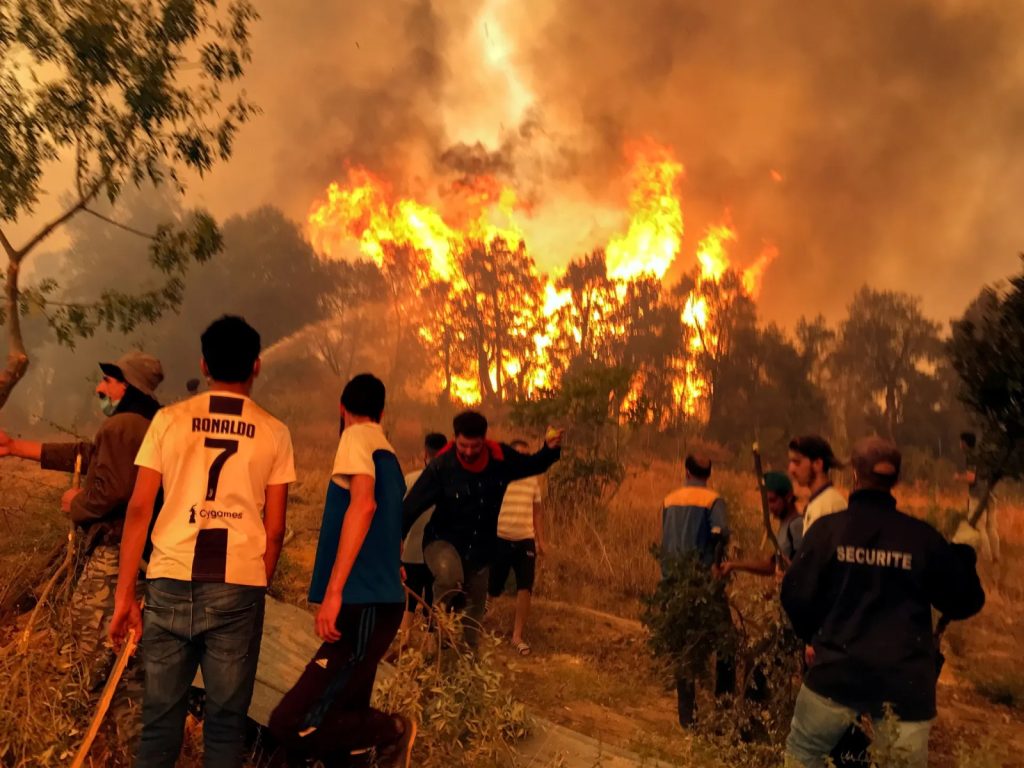
This comes after a recent waves of fires were reported across several of the country’s eastern provinces that claimed 12 lives, the cause of which is still being investigated by the authorities.
The death penalty is already present in Article 5 of Algeria’s penal code for several offences, but the country has placed a temporary suspension on executions since 1993.
The call makes for an interesting legislative precedent on the continent if passed, as Africa not only has a long history of using fire as a land management method but continues to top the chart in wildfires globally.
According to the SADC Fire Management Programme published in 2010, “Africa is the most fire-prone continent in the world, and people in the SADC region have been using fire for hundreds of years to prepare the land for agricultural, hunting, and other land management activities.”
In August of 2016, Namibia hosted the Third African Dryland Conference, which was held in Windhoek from the 8th to the 11th of August.
It was during this conference that the Africa – The Fire Continent report was first published.
The Africa – The Fire Continent report is a result of the need for clarification of the historical practice behind the use of fire as a land management tool.
David Daitz, a senior employee of Kishugu with extensive knowledge of forestry and conservation management, wrote an unsolicited paper addressing the importance of proper fire management in Africa.
The primary recipients of the report were development agencies like the World Bank that were pouring money into forest fire combating initiatives with little understanding of the historical reasons behind the practice.
Daitz began to gather all the information needed for that clarification from 2014. With extensive knowledge of forestry and conservation management, wrote an unsolicited paper addressing the importance of proper fire management in Africa.
Africa is known as the “fire continent”, accounting for about 70% of the world’s total annual burned area and about 50% 27 of fire-related CO2 emissions, according to the Social Science Research Network (SSRN) ’s State of Wildfire in Africa 2025-26 report.
According to the International Association of Fire Services CTIF, (“Comité Technique International de prevention et d’extinction de Feu”), by the 1st of June 2025, 102 million hectares of land were recorded to have burned for that year alone, and Africa accounted for about 53 million of the 102 million hectares.
The controlled burning the practice is used to meet objectives often essential to sustaining livelihoods; fire is also used for conservation reasons, including the removal of old growth.
The practice is also used in the suppression of bush encroachment and stimulation of the growth of grazing grass as well as the removal of fuel to pre-empt dangerous wildfires at the peak of the fire season, according to SADC.
The SSRN’s State of Wildfire in Africa 2025-26 report indicates that Central Africa has shown a decline in burned areas, except for a few countries including Angola, the Democratic Republic of Congo, Congo Brazzaville, Gabon, and Zambia, which recorded a slight increase.
Algeria’s capital punishment for intentionally starting forest fires is still in the legislative process, but if passed would make it the first on the continent to give capital punishment for such a crime.
State television said any death sentence would only be carried out after all legal avenues of appeal had been exhausted.