
By: Dwight Links
Two senior Namibian environmental experts, from the Research and Information Services of Namibia (RAISON) and the Namibia Chamber of Environment (NCE), have weighed in on pumping water from the Kavango River to the Central Regions of Namibia.
The two experts dissected the issue during a webinar last week that was based on the news of the planned Kavango Link project and its impact on the ecological systems communities present and along the Kavango River.
Over the past two months, media reports have indicated that inhabitants are strongly opposed to the project in its entirety, which is listed as a NamWater project.
The project’s summarised aim is to channel water from the river to the central areas of Namibia.
Shanice Ngeve, the moderator for the webinar, explained that the river is one of Namibia’s most important water resources, supporting communities’ livelihoods and biodiversity.
She said the government recently proposed the project, which has sparked important conversations on water security, environmental management and the future sustainability of Namibian water resources.
John Mendelsohn from Research and Information Services of Namibia believes that the ‘help yourself attitude’ exhibited by Namibia, Angola and Botswana will prevail.
He said even though the three neighbours actually have a commission known as OKACOM – similar to the ORASECOM one between Namibia, South Africa, Botswana and Lesotho, the attitude is different.
“This behaviour will prevail, and would gradually lead to a decline in water levels of the river and occasionally running dry,” he explained based on observations of recent developments on Namibian and Angolan developmental agendas associated with the river.
DYNAMICS
The presentation by Mendelsohn outlined that more people live along the Kavango River on Namibia’s side.
“As you can see, there are more people on the Namibian side than on Angola’s side where the majority of the river is,” he added.
He added that many other economic activities which are based on the river itself rely greatly on the river’s soil fertility, which is something many inland parts away from the river are not as good as close to it.
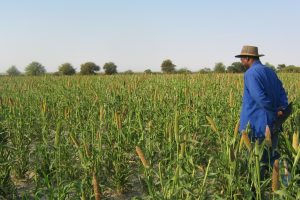
Mendelsohn named “serious” agricultural developments, such as the Green Schemes and other agri-projects that are pumping water from the river.
On the Angolan side, Mendelsohn indicates that Angola also wishes to do the same as the Kavango Link project and pump water into dams from the river to distribute further inland to other areas of our northern neighbour.
The river forms part of the Okavango Basin, which, according to him, has special qualities in terms of economic, environmental, and hydrological aspects. The river is shared by Namibia, Angola and Botswana as the basin covers all three nations.
“Large parts of the river are based in Angola, and then it flows down to Namibia at Katwitwi, north of Nkurenkuru, and then to Rundu and out to Mohembo in Botswana at the world-famous Okavango Delta,” Mendelsohn described.
The rains in Angola, where the river system starts, is considerably higher than in Namibia and Botswana, which is mostly observed annually when the flood waters stream from Angola towards Namibia and the Delta in Botswana.
Mendelsohn’s presentation outlined that there is another river that depends on and works with the Kavango River – the Cuito River – which is vital to the existence of the basin in its entirety.
ORIGINS OF THE KAVANGO LINK
Chris Brown from the Namibia Chamber of Environment indicated that the actual origins of the Kavango Link proposed project has its roots back to 1974, exactly 52 years ago.
“It was a water master plan for the central parts of Namibia back then. This is an out-of-date plan and obsolete,” Brown explained.
Brown provided support for parts of Mendelsohn’s presentation on the future if the proposed pumping from the river on both sides begins, in that with a warming climate, the river’s flowing capacity is naturally under strain.
“John [Mendelsohn] touched on climate change, and the projections on climate change alone are that we will lose a third of the water in the system. This will range from a quarter to a third,” Brown added on the warming climatic conditions that would increase evaporation.
This projection is based on a period of 20 years.
Brown noted that another study he was part of 15 years ago discovered that taking water from Rundu was not feasible.
“The engineers realised that there would not be enough water to channel to central Namibia. They then identified that it would be sensible to move the off-take 100km to the confluence with the Cuito River to make it feasible,” he added.
His conclusion on this point is that in 15 to 20 years, the same amount of water would not be available as at the start of the project if it materialises.
“You will have to start looking for another source of water anyway. So, why go through a project and spend N$ 7 to 9 billion on water you do not control and which is in the hands of climate change and the Angolans?” Brown questioned.
Another problematic point highlighted is that of the tourism economies of Namibia and Botswana.
Brown explained that Botswana’s entire tourism economy functions solely around the health of the Okavango Delta.
“Whereas Namibia is spoiled in that we have multiple tourism sites and activities. So, if the Delta is damaged because of water extraction, then Botswana’s tourism is damaged,” he added.
Brown stated that this will bring Namibia into direct conflict with Botswana.
“This is the last thing we want, particularly where we have other options,” he concluded.