

By: Annakleta Haikera
Farmers at the Salem Green Scheme Project near Uvhungu-Vhungu village in Kavango East say a lack of reliable markets and poor water supply continue to threaten their livelihoods despite years of investment and training.
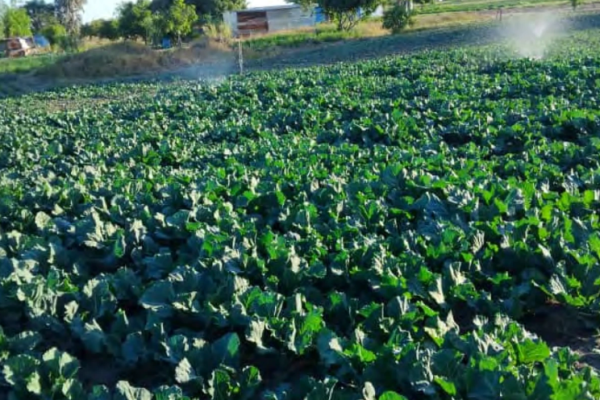
The community-owned irrigation project, established in 1985, currently has about 47 farmers cultivating approximately 34 hectares of land.
Most of the farmers at Salem are women who rely on crop production to support their households and generate income.
The project has become an important source of livelihood for many families in the area.
Farmers produce onions, cabbage, spinach, tomatoes, maize, sweet potatoes, carrots and other vegetables for household consumption and income generation.
Magdalena Jose said one of the biggest challenges facing farmers is the lack of access to formal markets.
“When we approach shops and retailers to place orders with us, they refuse. We do not know what criteria they use.
Some even dictate prices to us instead of allowing us as producers to set prices. In the end, we are forced to sell our products at very low prices,” she said.
Jose, who has been farming for the past three years alongside her grandmother on a one-hectare plot, said the project has helped many families generate income, but limited market opportunities are reducing profits.
“We produce good quality vegetables and have received training on farming and marketing, but finding buyers remains difficult. Most of our produce is sold to street vendors and open markets. We need more support to access bigger retailers and institutions,” she said.
Another farmer, Sikukutu Johannes, said farmers are often left with surplus produce that cannot be sold in time.
“When crops are ready for harvest, we struggle to find buyers. Some vegetables end up going to waste because there is no guaranteed market. We need assistance to connect with supermarkets, schools and other large consumers,” he said.
Local street vendor Maria Kambonde, who regularly buys vegetables from Salem farmers, said the produce is fresh and affordable, but farmers need stronger market linkages.
“The vegetables from Salem are of good quality. If shops and institutions bought directly from farmers, it would help them increase their income and reduce losses,” she said.
Apart from market access, farmers continue to face water challenges.
Water is pumped from the Kavango River at Kaisosi River Lodge, approximately one kilometre away, resulting in low pressure by the time it reaches the gardens.
Agricultural expert Lucas Mandema said farmers should seek assistance from the Food and Agriculture Organization (FAO), the Ministry of Agriculture, Fisheries, Water and Land Reform, and the Rundu Town Council, which may have funding opportunities available for small-scale farmers.
“The farmers should approach FAO, the Ministry of Agriculture and even the Rundu Town Council to find out whether there are funds available to support small-scale farming projects. These institutions can assist with infrastructure, production and marketing support,” Mandema said.
He added that constructing a pond near the gardens would significantly improve water availability.
“The water source is about one kilometre from the gardens, which is a long distance. Building a pond or water storage facility closer to the fields would help improve water supply and irrigation efficiency,” he said.
The Salem project previously received N$6.6 million through the Crave Project, which funded solar panels, pumps, fencing, tractors, irrigation infrastructure, seeds and farmer training.
However, farmers say further support is needed to address water shortages and secure stable markets to ensure the long-term sustainability of the project.
Ministry of Agriculture, Fisheries, Water and Land Reform spokesperson, Romeo Muyunda, said he was not aware of the situation at the Salem Green Scheme Project.
Muyunda said the Ministry is working to support and strengthen several horticulture projects and community gardens across the country this year.
He requested that detailed questions regarding the challenges facing Salem farmers be submitted to his office, adding that the Ministry would investigate the matter and provide feedback as soon as possible.
“I am not aware of the situation at Salem at this stage. However, the Ministry is working on a number of horticulture projects and gardens this year. If questions are submitted to us, we will look into the matter and respond as soon as possible,” he said.
Salem is a cooperative irrigation project situated about seven kilometres east of Rundu near Uvhungu-Vhungu village.
The project was established in 1985 on 10 hectares and later expanded to 53 hectares, of which about 34 hectares are currently under production.
The majority of the project’s farmers are women, many of whom depend on agriculture as their primary source of income and household food security.