



By: Dwight Links
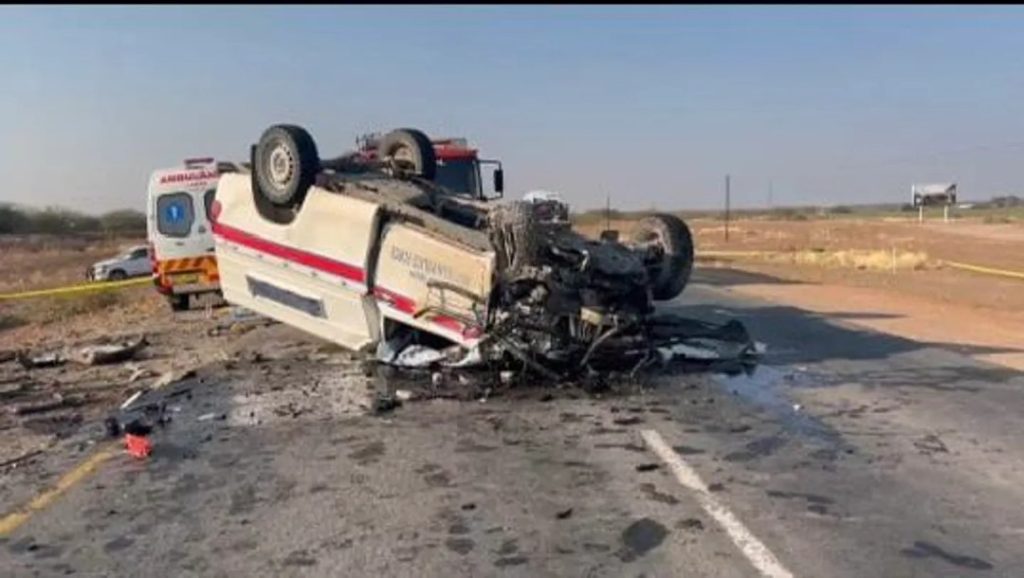
A recent report from the National Council’s Standing Committee on Transport, Infrastructure and Housing placed most road accidents and fatalities solely on the actions of drivers.
Titled ‘Urgent Need for Critical Measures to Curb the Rising Road Accidents Crisis in Namibia’, the members of parliament said that they acknowledge that most blame lies with the drivers and road users, but did not fully place the blame there.
“Human behaviour remains the dominant contributor, particularly actions like speeding, reckless overtaking, alcohol impairment, fatigue, distraction, and disregard for traffic laws,” the report outlined.
The national stakeholder engagement took place from 6 to 31 July 2026. According to the National Council, all public stakeholders and regional government representatives were engaged to garner insights into the report.
NAMPOL, the Motor Vehicle Fund, and the Roads Authority, and other institutions provided statistics on crashes for a three year period from to 2024 to mid-2026.
Total crashes were the most alarming statistic. The 2026 tally, which is by far the most concerning, with the rate of vehicle crash incidents being double that of 2025 and 2024.
2026 so far has 1,287 crashes in total, with 2024 being second with 577 and 2025 having 538.
20226 also leads in the most fatal crashes (deaths from crashes) with 229 as of July 2026. 2024 had 20, and 2025 only 15.
In terms of the injuries that were recorded from these three years, 2026 already had 2,189 serious injuries. 2024 had 67 and 2025 recorded 74.
The MPs noted that there is a general consensus of the seriousness that accidents on road pose.
“The evidence before the committee demonstrated that road crashes constitute a national public health, a socio-economic and a development crisis. However, through these hearings, it was also established that driver behaviour cannot be isolated from infrastructure, vehicle roadworthiness, enforcement capacity, emergency response, public transport regulation, land use planning and institutional coordination,” the National Council stated.
The reason for the report stems from the extensive public hearings that the standing committee conducted throughout the country. These were conducted as stakeholder engagements and regional public hearings wherein the responses from these engagements would possibly provide new approaches to dealing with road accidents.
“The engagements were intended to move the national discussion beyond identifying causes and towards practical, measurable and accountable interventions,” the report said.
Regional Concerns
One blanket conclusion the committee reached was what they observed in every regional engagement. These were issues related to basic road traffic signals and signs, proper indicators for traffic users and other stakeholders like pedestrians to properly navigate along and around roads.
“The committee’s most important conclusion is that the repetition of the same concerns across regions is evidence of systemic weaknesses.”
“Shortages of traffic officers and enforcement equipment, poor pedestrian facilities, inadequate traffic signs and lighting, animals on the road, deteriorating roads, weak vehicle-testing capacity and delayed emergency response were repeatedly reported,” the committee cited as regional takeaways.
On a region-specific approach, the report identified that there are major individual risks that contribute to the above scenarios always manifesting, and some of these require more immediate responses than any other.
“In terms of the regional hearings, the first were the presence of livestock and wildlife risks in rural corridors. Another is extreme freight pressure in Erongo and Otjozondjupa, the B1 Corridor fatalities in Hardap and Kharas, In Kavango West where domestic animals account for more than 51% of recorded crashes, severe pre-hospital responses challenges in Kunene, inadequate non-motorised transport infrastructure in Eenhana, and heavy cargo pressure along with a proposed railway alternative in Kavango East,” the committee explained their findings for immediate interventions.
The committee’s suggested recommendation is that the “whole of government and the whole of society approach” is needed to provide change on these major factors that contribute towards accidents and tragedies.
“This should be complemented by continuous public education, professionalised driver training, improved medical training, improved emergency medical response, with integrated and reliable accident data systems. On organisations affiliated to responses, greater institutional accountability is needed to ensure coordinated and measured response actions to accidents,” the report said