


Photo: Contributed
By: Nghiinomewa-vali Hangala
The developer of the Haib Copper Mine in southern Namibia has reported that the Definitive Feasibility Study (DFS) to guide the development of the copper mine will be completed by next year.
Koryx Copper, which is doing the metallurgical assessment of the reserve, announced this as part of their interim update on the Pre-Feasibility Study Progress for the project.
In mining, a DFS determines if the found mineral reserve is investment-grade, providing a detailed technical and financial basis for a decision to develop the mine and finance the project.
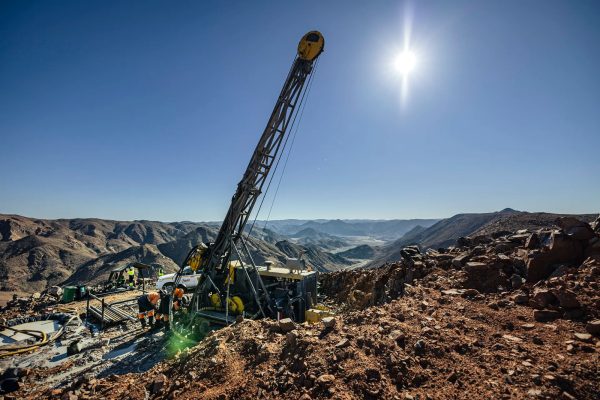
According to Koryx, their metallurgical program for the DFS is well underway, with drill core and pilot bulk metallurgical sample selection having commenced in August.
The sample selection is focused on building a comprehensive geo-metallurgical model for both comminution and flotation aspects of the Project during the DFS planned for 2027, the miners said.
The miners updated that their pre-feasibility study has met test work results near completion and is showing consistency with historical results, thus supporting PFS metallurgical assumptions and by-product recovery potential.
In terms of bulk water supply, once the DFS is reached, the developer/Koryx will sign a MoU with NamWater. An Infrastructure Development Agreement for the bulk water supply system will be developed.
The Orange River supply scheme was selected as the preferred, lowest-cost bulk water supply solution for the proposed mine, with a single abstraction point approximately 9 km south of the mine.
The mine developer has also explained that with the expected increase in the process plant throughput to 48 Mtpa, the project’s electricity requirements have increased accordingly.
The current power demand estimate is 260 MVA. Maximum demand and annual electricity consumption is estimated as 1.45 TWh, reflecting the larger scale of the operation and associated infrastructure requirements.
The Project’s power supply strategy remains centered on a connection to the NamPower grid, supplemented by solar photovoltaic (PV) generation and the integration of Battery Energy Storage Systems (BESS) to reduce overall energy costs and manage peak tariff periods.
Adding that the planned double-circuit 68km long 220 kV overhead transmission line from the Harib substation to the mine site remains a preferred and technically robust solution, and is expected to provide sufficient scalability to support the project’s long-term development plans.
As for the Environment and Social Impact Assessment and Environment Management Plan, which will support the Environmental Clearance Certificate application for the Mining License Area and Water Abstraction were submitted to MEFT on 19 August 2026 and 4 September respectively.
The decision is expected before the end of 2027.
All workstreams are on schedule to support PFS publication before the end of November 2026, the developer stated.
Koryx has also indicated that the plant layout has been finalised to optimise the use of the project terrain and minimise conveying distances, bulk earthworks, mine-to-crusher haul distances, utility requirements, and the overall footprint of processing and mining services.
“It also allows for future expansion through additional front-end and flotation circuits, should the project be expanded,” the statement revealed.
According to Koryx, Haib is a large copper porphyry deposit in southern Namibia with significant gold and molybdenum credits and a long history of exploration and project development by multiple operators.
Namibia is one of Africa’s most established mining jurisdictions with more than 120 years of continuous mining history and active mines in diamonds, uranium, gold, and copper.
erastus@thevillager.com.na