



By: Annakleta Haikera
For four years, Visentius Kapumburu experimented with discarded materials, driven by a curiosity that few around him fully understood in Gcwagi Village, Kavango West Region.
With little formal education and coming from a family with limited means, the young innovator turned his hands, imagination, and whatever materials he could find into tools aimed at solving everyday problems.
Now, that persistence has opened a door he once could only dream of: an opportunity to return to school and receive formal technical training.
Kapumburu, who left school in Grade 3, says his innovation journey began in 2022. Since then, he has spent years experimenting with electricity, electronics, and mechanical projects from his home.
One of his most remarkable experiments involved using positive and negative plates recovered from old car batteries and other discarded materials.
Placed in a bucket of water, the setup was able to generate enough electricity to power lights, charge mobile phones, and operate radios.
He also developed an interest in repairing smartphones and working with electrical components.
At one point, Kapumburu built a powered toy aircraft. However, the aircraft reportedly flew away after he failed to control it because he did not have a radio-control unit.
For Kapumburu, the experiments were never simply about entertainment. They were his way of learning.
“Not everyone is good in books. Some of us use our hands to survive,” he said during an interview with Eagle Media House.
“I have become a breadwinner in my family because I did not give up, despite my situation,” he said.
Kapumburu’s story was initially highlighted by MICT Kavango West, which drew attention to his technical abilities.
His story gained further attention after Eagle FM shared a summary of his journey, prompting a well-wisher to offer N$1,000 and call for the Ngato Institute of Science and Technology (NIST) to consider allowing him to undergo technical training.
That appeal eventually opened a much bigger door.
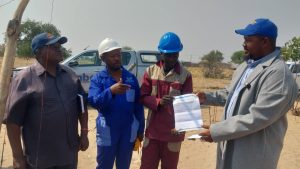
Members of the NIST board visited Kapumburu and his family to see his technical abilities for themselves.
The visit became more than an assessment of his skills. It was an acknowledgement that talent and innovation can emerge outside the traditional classroom.
NIST subsequently awarded Kapumburu a three-year scholarship, covering his approved tuition and applicable academic fees, as well as food and accommodation during his studies.
According to an award letter dated 2 September 2026 and read by Laurens Thabo Ortmann, Kapumburu will study from Level 1 to Level 3 over the three years.
Ortmann said the scholarship was awarded in recognition of Kapumburu’s commitment to education and his potential to successfully complete the programme.
The institution encouraged him to maintain good academic standing, attend classes regularly and comply with its rules and regulations throughout the scholarship period.
Ortmann said the training would equip Kapumburu with the knowledge, skills and experience needed to contribute positively to his community and the development of Namibia.
Kapumburu is expected to travel to Rundu on 7 September to begin his studies.
Behind Kapumburu’s journey is a mother who says she spent years struggling to raise seven children after their father left the family without support.
Veronica Kapumburu, 42, told The Villager Newspaper that raising her children was difficult, with the river becoming one of the family’s main sources of survival.
“I used to wake up early in the morning and go to the river and look for fish, or I would do odd jobs for people to pay me with maize meal,” she said.
“Sometimes I would fetch water for people and they would pay me. Most of all, the river was our only hope to survive,” she expressed.
For Veronica, the scholarship means more than her son acquiring technical skills. It fulfills a prayer she says she made repeatedly while watching her son grow up without the opportunity to continue his education.
She expressed gratitude to everyone who helped bring Kapumburu’s story to the attention of Namibians and to those who contributed towards easing the family’s struggles.
But she said her greatest gratitude goes to NIST for allowing her son to return to school.
Sikere Kangumbe, a member of the village development committee, said the community had watched Kapumburu work with scrap materials and attempt to create or repair things with whatever he could find.
“He was only working with different scrap materials and trying to fix something out of nothing,” Kangumbe said.
He said Kapumburu’s determination showed that there was a talent inside the young innovator that refused to give up despite his circumstances.
For Kapumburu, the journey from a Grade 3 dropout experimenting with scraps at home to a student receiving a three-year technical scholarship is a reminder that talent does not always begin in a classroom.
annakletahaikera@eaglefm.com.na