




Photo: Contributed
By: Nghiinomenwa-vali Hangala
Namibia has experienced one of its worst months in terms of electricity generation, generating only 144,625 MWh in August 2026.
This is only 35% of what the country consumes, according to the latest sectoral report compiled by the Namibia Statistics Agency (NSA).
The report tracks the country’s monthly electricity generation from various sources and imports.
The latest report, which is for August 2026 shows that total electricity supplied to the domestic economy stood at 413,763 MWh, down from 435,543 MWh supplied in July 2026.
However, the country’s energy sources could only generate 35% of Namibia’s needs, forcing the country to import the rest.
According to the NSA, the dip in local energy generation is the norm during that time of the year.
“This composition remained broadly consistent with July 2026 and August 2025, whereby electricity imports accounted for the largest share of total electricity supply,” the NSA explained.
The Ruacana Hydro Power Station remained the largest source, generating 108,656 MWh, equivalent to 75.1% of total domestic output.
Independent Power Producers (IPPs) were the second-largest source, contributing 30,939 MWh (21.4 %), followed by Omburu PV Solar Power Station, which generated 4 771 MWh (3.3 %).
The Anixas 2 Diesel Power Station contributed the smallest share among the active generation sources, producing 259 MWh (0.2 %) of total domestic output.
In terms of imports, Namibia imported a total of 269,137 MWh of electricity during the month under review, the highest for the year.
Most of it was imported from Eskom Aggeneis, South Africa, accounting for 46.3% of total electricity imports.
ZESCO Limited of Zambia followed with a 32.9% share.
South Africa and Zambia keep trading places in terms of supplying Namibia.
While 16.5% of total electricity imports was procured from Zimbabwe Power Company (ZPC).
Eskom Orange River accounted for the remaining 4.3% of total electricity imports.
Meanwhile, the Southern African Power Pool (SAPP) Day-Ahead Market recorded no electricity imports to Namibia during the month under review.
In terms of domestic electricity sales, they totalled 326,354 MWh in August 2026, slightly down from 328, 991 MWh sold in July 2026 but higher than 321,495 MWh recorded in August 2025.
Domestic electricity sales is also one of the economic indicators, as electricity consumption highlights economic activities.
Redistributors remained the largest consumers of domestically supplied electricity, as they buy in bulk and redistribute, accounting for 67.3% of total domestic electricity sales.
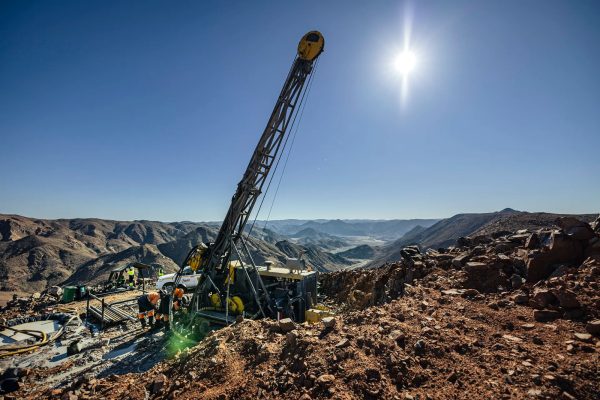
The mining sector is the second-largest consumer and also the largest consumer at the sector level, accounting for 24.9 percent.
Farms under the main supply category accounted for 1.3% of total domestic electricity sales.
“Plots and Miscellaneous Properties” and “Commercial – Large Power Users” ranked fifth and sixth, respectively, each contributing 0.8 percent of total domestic electricity sales during the period under review.
Funding Strategy Baynes Project Implementation
According to the Minister of Mines and Energy, Modestus Amutse, speaking from Angola, updated that financial advisors have devised a funding model to fund the development of the Baynes Binational Hydropower Project.
“I understand that the Baynes Project Implementation Unit and its financial advisors have developed a Funding Strategy for the Project, which will now be presented to the two governments for consideration and determination of the most suitable funding model,” he said.
Amutse acknowledged that the two countries are now starting a process of advancing an important strategic infrastructure towards the eventual commencement of the construction thereof, “within the soonest possible timeframe.”
Adding that the strategic importance of the Baynes Binational Hydropower Project cannot be overstated.
Namibia remains a net importer of electricity from its neighbours, and “we are fortunate to benefit from strong and mutually beneficial regional relationships,” Amutse acknowledged.
Adding that the Hydropower project is therefore a necessary enabler of energy security for the two countries and, by extension, for the wider region.
Amutse also acknowledged that the government is aware that hydropower development is capital intensive.
As a result, the two governments have resolved to develop the Hydropower Project through a public implementation model, under which the required funding will be mobilised in a manner that supports competitive and affordable tariffs for end consumers.
The energy minister has also flagged that the project has been under planning for many years, with the first studies on the initial Epupa site undertaken in the 1990s and the feasibility studies on the Baynes site undertaken since 2008.
“It has been an extremely lengthy process. It is now time to bring the development phase to a clear conclusion and move towards the construction of this much-needed energy infrastructure project,” he stated.
erastus@thevillager.com.na