



By: Mathias Hangala
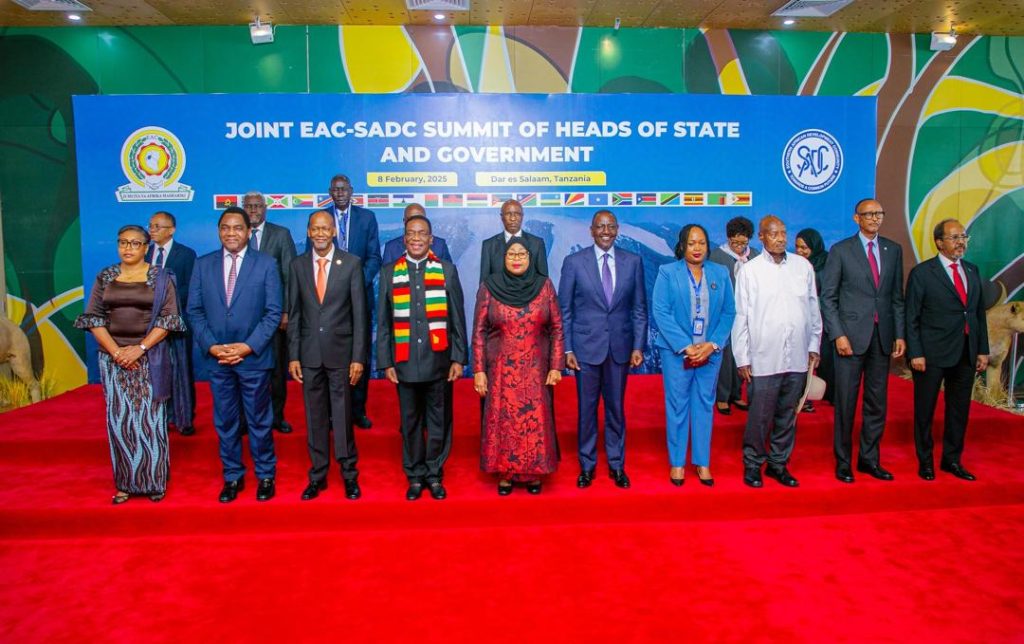
The East African Community (EAC), Southern African Development Community (SADC), and the African Union (AU) convened on Thursday in Nairobi for high-level talks aimed at resolving the ongoing security crisis in eastern Democratic Republic of the Congo (DRC).
The meeting was jointly chaired by Kenyan President William Ruto (EAC chairperson) and Zimbabwean President Emmerson Mnangagwa (SADC chairperson), bringing together key delegates and facilitators from the EAC, SADC, and AU. The gathering focused on mobilising resources to support peace efforts, with a particular emphasis on humanitarian aid.
The African Union (AU) was tasked with overseeing the coordination of these resources to ensure a timely and effective response to the needs of civilians affected by the conflict.
This development comes on the heels of the Democratic Republic of the Congo-Rwanda peace agreement, also known as the Washington Accord, which was signed on June 27, 2025, in Washington, D.C. The treaty, brokered by the United States (U.S) and Qatar, was signed by the foreign ministers of the DRC and Rwanda. However, the Rwandan-backed rebel group, the March 23 Movement (M23), was not a party to the agreement, though it remains a central actor in the conflict.
The Washington Accord outlines a 90-day timeline for the withdrawal of Rwandan troops from eastern DRC and calls on the Congolese government to cease its support for the Democratic Forces for the Liberation of Rwanda (FDLR), a militia opposed to the Rwandan government. It also proposes a regional economic integration initiative involving both countries, with support from the U.S.
Eastern DRC has been plagued by instability since the 1990s, when Hutu militias fled into the region following the Rwandan genocide. The region is now host to more than 100 armed groups, including M23, with many analysts attributing the persistent conflict to ethnic rivalries, foreign interference, and competition over the area’s vast natural resources—some of which are critical for technologies such as computers and drones manufacturing.
Namibia has also taken a firm stance. Speaking at the recent SADC Ministerial Committee of the Organ on Politics, Defence and Security, held in July in Dar es Salaam, Tanzania, Namibia’s Minister of International Relations and Trade, Selma Ashipala-Musavyi, condemned the role of Rwanda and M23 in destabilising the DRC. She reaffirmed Namibia’s commitment to supporting peace efforts in the region and emphasised the importance of humanitarian aid, citing it as the key focus area.
The human cost of the conflict remains staggering. It is estimated that over 6 million people have died as a result of the violence since the 1990s, with more than 900,000 displaced. Some have fled as far as Namibia, seeking asylum in camps like the Osire Refugee Camp in the Otjozondjupa Region. Reports indicate that some asylum seekers have been denied refugee status, raising further humanitarian concerns.
As regional and international stakeholders work together to implement the Washington Accord and navigate the complex web of alliances and hostilities in eastern Congo, the hope remains that sustainable peace and stability can finally be achieved in one of Africa’s most conflict-ridden regions.