



By: Dwight Links
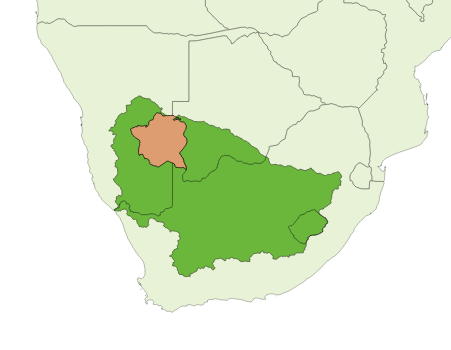
According to researchers, the disputed Stampriet Transboundary System is not an aquifer, but rather a basin.
In the basin, there is a collection of aquifers in the region of Headsprings Investments’ exploration activity. This was outlined at a recent media engagement on the ongoing interest in installing an In-Situ Recovery/Leaching project in the east of Namibia.
The basin consists of the Kalahari, Aoub and Nossob aquifers.
Vanessa Bohitile, Headsprings Investments deputy director, said that there is much confusion surrounding information on the aquifers forming part of the basin.
According to the company’s director, Kirill Egorov-Kirillov, farmers in the Omaheke Region tap into the top aquifer, which is the easiest to access.
Egorov-Kirillov noted that the farmers never tested their own water before, stating that there is no way for them to establish how long the water could have been impacted by the existing uranium ore body.
According to Headsprings, no other entity has collected or run tests of that nature in the region.
“This project is an eye-opener; when we started doing our baseline data collection, which included our sampling from boreholes from the farms as well, these boreholes already had elevated levels of exposure to the uranium ore,” explained Abel Nghifitikeko, Headsprings operations manager.
Egorov-Kirillov added that there is a small deposit of the ore body, but that the mineral lies in some shallow, accessible water bodies in the region, while some of it lies deeper beneath the surface.
“It could be as shallow as 200 metres in the shallowest place,” Egorov-Kirillov said.
Bohitile added that on Botswana’s side, there is interest in tapping into what is now known as the Kalahari Copper Belt – a large deposit of copper ore that spans from northern Botswana down to eastern Namibia.
The activity, however, is planned to be further inland from the Namibia/Botswana border as this project is closer to the centre of Botswana.
Contamination Dimensions
The Headsprings team responded to questions on monitoring and spillage detection, contamination and mitigation strategies in the event of damage to a pipeline or any other infrastructure during operations.
Nghifitikeko noted that the process Headsprings uses is a ‘five-spot’ system by having five boreholes on the site.
“You have four injection boreholes and one extraction [borehole]. There are strategically placed monitoring boreholes placed [on site]. And these monitor supply samples on certain intervals,” Nghifitikeko outlined.
He indicated that any exploration outfit would already have baseline data or knowledge to work from.
“So, should you detect a deviation in sample readings that you take, then you would realise that there is something wrong in the system,” he added.
In-Situ Recovery/Leaching technologies have also advanced as the company explains that there is 24-hour surveillance of the solution being pumped below ground, and the infrastructure’s integrity during operations.
Nghifitikeko indicated that if the monitoring team on site realises that there is no activity in terms of pumping the solution to extract the ore body, the underground pressure will also play a part.
“All the boreholes have detectors – and this is if we go into operation. Everything is automated and the monitoring team will see this on screens on site. Even if there is no one to shut down this system – it has a failsafe built into it to automatically shut down,” Nghifitikeko explained.
IAEA Feedback
The Ministry of Environment, Forestry & Tourism confirmed earlier in May that the UN Security Council organisation – the International Atomic Energy Agency (IAEA) – has sent their report on their visit in February this year.
The Ministry’s communications office confirmed that this report is before the Cabinet, and will be made available after deliberations on its findings.