




By: Hee–Dee Walenga
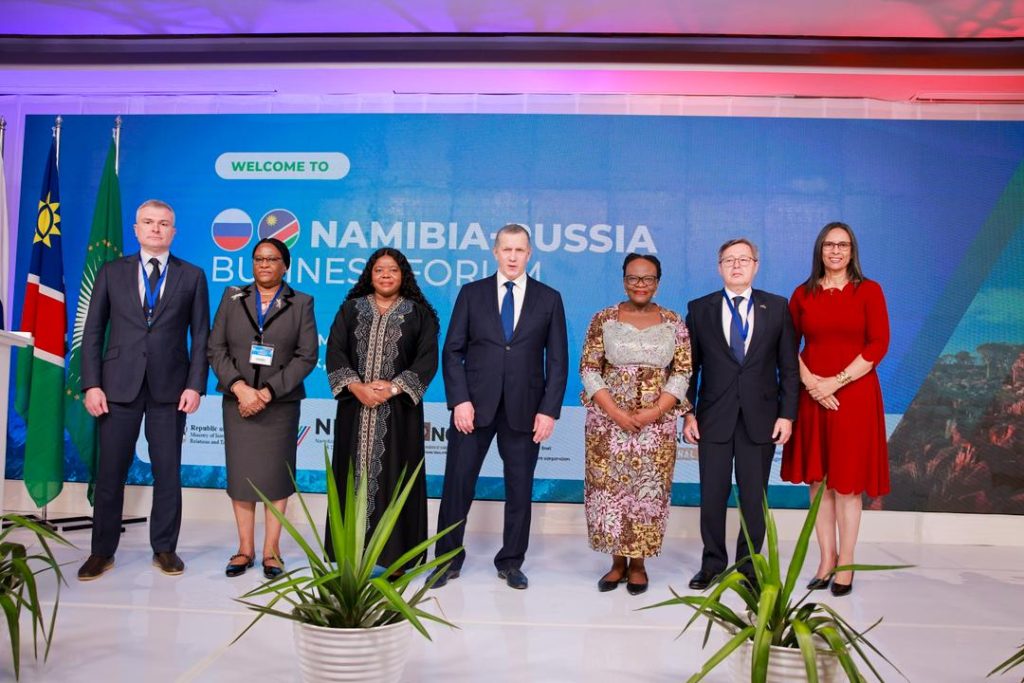
Stakeholders from public and private sectors alike gathered at the Windhoek Country Club on Friday for the Namibia-Russia Business Forum, which was held in tandem with the 11th meeting of the Russian-Namibian Intergovernmental Commission on Trade and Economic Cooperation.
Among the high profile guests in attendance were Namibia’s Minister of International Relations and Trade, Selma Ashipala-Musavyi, Acting CEO of the Namibia Investment Promotion and Development Board (NIPDB), Jessica Hauuanga, Russia’s Deputy Prime Minister, Yury Trutnev, and VEB.RF Deputy Chairman, Artem Dovlatov.
The forum included four panel discussions, one of which was held under the theme ‘Namibia-Russia: Horizons of Technological Partnerships of the Era of Digital Transformations.’ The panel included Communications Regulatory Authority of Namibia (CRAN) CEO Emilia Nghikembua, Namibia Standards Institute (NSI) CEO Eino Mvula, Business Connections (BCX) Managing Director Coenraad Coetzee, Executive Director of the Ministry of Health, Penda Ithindi, Telecom Namibia Senior Manager Ino Iyambo, Kaspersky Deputy Director Sergey Kozlov, Managing Director of Sk Capital Sergey Fedoseev, and Deputy Director of the Russian Association for Electronic Communications Yury Lindre.
The CRAN CEO expressed that the authority is transitioning from just regulation, compliance, and licence issuing to “Positioning ourselves to be a digital ecosystem builder.” Nghikembua outlined cybersecurity, public key infrastructure, digital infrastructure, and adoption of technological tools as key building blocks for Namibian-Russian cooperation to boost Namibia’s digitalisation.
“50% of our 4G LTE towers remain under-utilised because our people do not have the devices to make use of the towers,” Nghikembua stated.
Speaking on digitalising Namibia’s health system, Ithindi outlined five areas of investment needs, namely: infrastructure, medical technology/equipment, information systems, research, and human capital.
INFRASTRUCTURE
“We still have hospitals that do not have basic medical equipment and specialists. The government is investing in the construction of three hospitals as well as specialised units that we want to construct through public-private partnerships,” Iithindi stated.
MEDICAL EQUIPMENT & TECHNOLOGY
Iithindi stated that the government has a desire for the aforementioned facilities to be ‘smart hospitals.’
“They must have the required technology to improve on the current service delivery. The Russians are specialists in this, thus there is an opportunity for us to work together,” the Health ED stated. Ithindi added that improved technology would reduce waiting times for patients and improve diagnosis accuracy.
INFORMATION SYSTEMS
Ithindi noted that an efficient and interoperable information system is crucial for Namibia to effectively implement services such as telemedicine.
“We want our platforms and specialists to learn from the advances that the Russian federation has made in telemedicine, so that we can offer quality service to the people of Namibia without them having to travel long distances,” remarked Ithindi.
RESEARCH & SURVEILLANCE
The Health ED stated that if Namibia does not engage in research and implement research outputs, the healthcare system will remain in its current state. “Nations develop because of research and innovation,” he expressed.
Ithindi went on to mention that monitoring outbreaks of diseases such as polio, measles, and malaria can be simplified with technology such as drones, which would also allow the ministry to deliver medication to remote areas, according to him.
HUMAN CAPITAL
“We need specialists in all areas,” stressed Ithindi. According to him, there are sectors where Namibia only has two or three specialists in the whole country, such as radiology. Investment in this area would exponentially increase service delivery and reduce the volume of the waiting lists of the existing specialists around the country.