





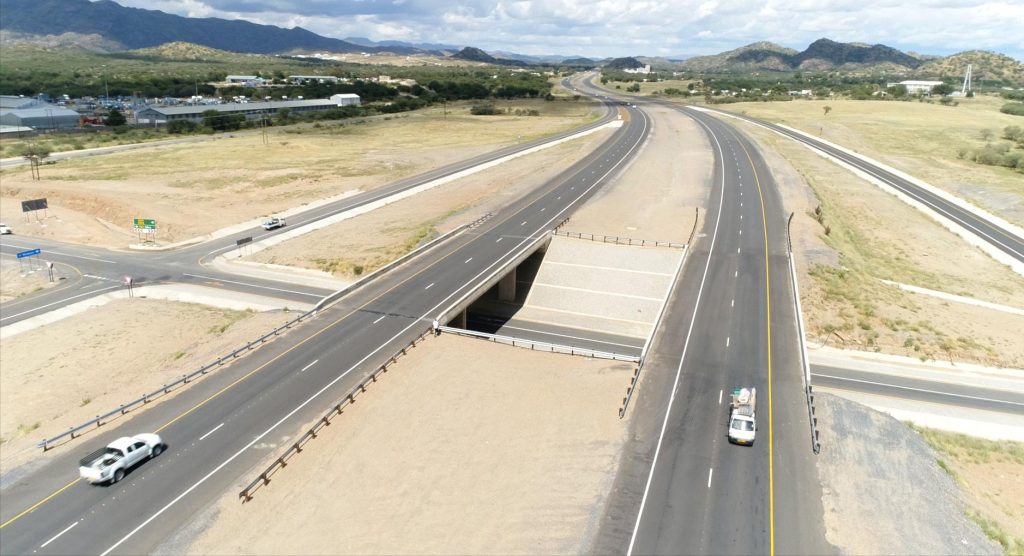
By: Kandjengo kaMkwaanyoka and Thokozani Saulosi
One issue that continues to prevail in various African countries, including Namibia and Malawi, is the persistent assumption that constructing roads automatically translates into higher economic growth. While it would make sense for an undergraduate student, in practical economic terms, the relationship is far more complex.
Economic growth refers to an increase in productive economic activities that generate additional value in the economy. In the context of roads, this would mean that the use of those roads facilitates or enhances value creation.
However, the roles of road infrastructure need to be unpacked further for those doing economic planning and funding national projects. It has to be understood that infrastructure in their economic nature are enablers and facilitators of economic activities – this can also be elaborated that in the absence of economic activities requiring such infrastructure, they are economically useless.
Thus, road infrastructure investment without adequate entrepreneurial support and other injections to drive up activities, the roads will not be used for commercial purposes, bringing value to the community.
Economic activities such as production across the country drive transactions and mobility, which lead to the utilisation of roads. Thus, if there is no value creation in the constituencies that received the road, the investment in the road will not yield much commercial value.
Consider two scenarios.
In the first, suppose the government constructs a road that leads to a farm. On the surface, one might argue that the road promotes growth by easing transportation. However, does that necessarily mean the farm is producing more output or reaching more customers? Probably not. If the farm continues to produce and distribute the same quantity of goods, the overall value added to the economy remains largely unchanged.
In the second scenario, imagine the road leads to a hotel somewhere in Lilongwe. Improved accessibility in this case is likely to attract more visitors, thereby increasing the hotel’s business activity and, consequently, generating measurable economic value. Here, road construction can be directly linked to growth.
That said, focusing primarily on road construction should not be mistaken for actual economic growth. For a poor country like Malawi, prioritising infrastructure over the productive economic activities that such infrastructure is meant to support is a misplaced approach.
For Namibia, given its position on the continent, it could be said that expanding connective roads is strategic, as it plans to be the gateway to the continent. However, road investment elsewhere should be complemented with other efforts to stimulate economic activities in the constituencies.
Roads shouldn’t be used only to go to hospitals, but for income-generating commercial-scale projects also – enabling access to market and wealth creation through the utilisation of constituency natural resources, etc.
Thus, every road investment should be accompanied by a commercial strategy for that particular constituency; a plan to stimulate and enhance commercial activities to take advantage of the road. Every public investment must be guided by rigorous cost-benefit analysis to ensure that the broader society maximises returns from government expenditure.
For instance, prioritising the establishment of mega farms before investing heavily in road construction to less productive areas would yield greater net benefits and minimise social costs.
In summary, restructuring the fiscal budget to focus on value-creating sectors is essential for achieving meaningful economic recovery and long-term stability. Perhaps the more fundamental question is whether the focus for a poor country such as Malawi and a developing economy like Namibia should be on economic growth or economic development.
The fundamentals of economic building need to be revised to meet and change the socio-economic impacts.
Every road investment must be weighed up; a strategy to stimulate economic activities along such roads is necessary because most of the African debts are for road infrastructure.
These roads are currently just being used to access clinics and hospitals, but with fewer commercial activities along them, and that can be changed through a different approach in planning and economic development.