



By: Nghiinomenwa-vali Hangala
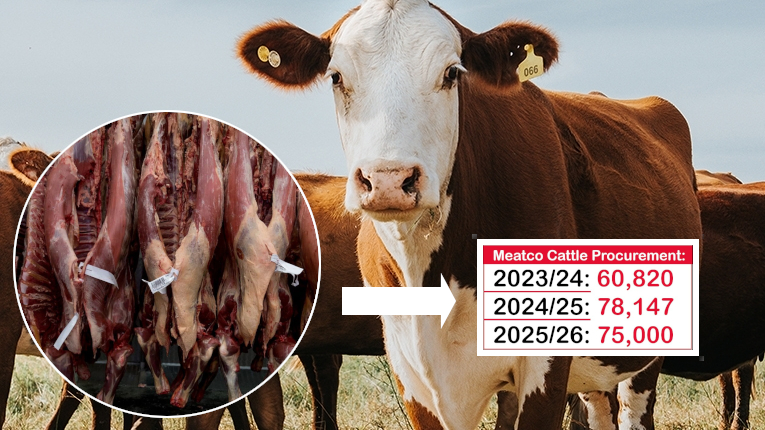
One of the country’s main beef processors, Meatco, has indicated that it has budgeted to slaughter 75,000 cattle for the Financial Year (FY) ending January 2026.
So far, the company has slaughtered more than 25,000 animals from the South and the North of the Veterinary Cordon Fence.
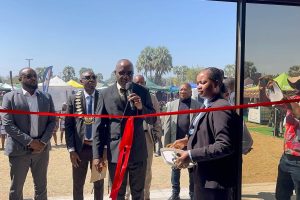
Meatco revealed its plan last week during the Farmers’ Seminar, which was concurrently held with other festivities at the Annual Okakarara Trade Fair.
During the meeting, Meatco engaged with farmers, who were predominantly communal farmers.
The company has also committed to procure 8,000 cattle from communal farmers, which will be the highest ever procured.
In 2023, Meatco slaughtered 60,820 cattle, surpassing the budgeted target of 50,000, paying a total of N$946 million to producers, according to the company’s 2023 annual report. Of these, only 5,056 cattle were procured north of the veterinary fence.
In 2024, according to the Livestock and Livestock Products Board of Namibia, Meatco has slaughtered 78,147 cattle. Since the company’s 2024 annual report has not yet been released, the amount paid to producers remains unknown.
Last year’s procurement was high due to de-stocking as a result of drought, as farmers liquidated their stock to avoid losses.
As for the 2025/26 financial year, the national beef producer plans to slaughter 75,000 head of cattle.
Meatco’s Livestock Procurement and Production Department has revealed that they devised a Communal Area South and North of the Veterinary Cordon Fence strategy.
“We aim to procure as many cattle from these farmers as possible,” the statement revealed.
In particular, for the south, this strategy, which is for the current financial period, aims to obtain approximately 8,000 cattle from communal farmers,
This will be done through permit days and direct deliveries to the Windhoek Abattoir by the farmers.
Additionally, the company has also announced its plan to use all the streams in the Communal Area, which include auctions, permit days, buying from individual farmers, and on-farm or village purchases.
The corporation also plans to embark upon enhancing its background initiatives by buying steers at 280kgs, highlighting that they will share more information on the initiative in due course.
Furthermore, there are plans by the Otjozondjupa and Omaheke Farmers Unions to start small-scale feedlots. For this, Meatco indicated that they will approach the unions by supporting and sourcing cattle from these established feedlots for direct slaughter or backgrounding, depending on their age and weight.
In terms of pricing, Meatco has announced that for the period August to October 2025, they are paying a price of N$68.50/kg for A2-4, AB2-4, and B2-4 grades. From November 2025 to January 2026, they will offer N$70.00/KG for A2-4, AB2-4, and B2-4 grades.
Additionally, during this period, the C2-4 grades will be N$66.00/KG for cattle brought directly to the abattoir, as part of the strategy to stabilise prices.
Meatco revealed that the Okakarara meeting was to foster resilient farming practices geared towards turning farming into competitive and sustainable farming enterprises that can enhance the livelihoods of communal farmers.
“It is, therefore, necessary for us to continue creating platforms where farmers can market their animals to Meatco with ease,” the statement read.
Namibia has 2.5 million head of cattle (0.25 per cent of all cattle in the world).
The production of beef worldwide is estimated to amount to 361 million tonnes in 2023, compared to Meatco’s 29,120 tonnes produced in 2023/24.
Worth N$6.3 billion, Namibia’s livestock farming sector is said to be in dire need of growth at the farm level, but will only happen when it is profitable to producers.
Last month, Simonis Storm’s analysis detailed that the country’s beef exports’ collapse in the first half of 2025 was one of the most significant economic shocks Namibia has experienced in recent years.
Their analysis revealed that exports in the first quarter fell by 51.4 percent year-on-year to 1.43 million kilograms, while the second quarter saw a further 49.7 percent decline to 4.04 million kilograms from more than 8 million the year before.
Simonis Storm stated that the first half contraction is not the result of vanishing global demand.
“On the contrary, demand for Namibian beef remains strong in Europe, Norway, and Asia. Rather, it reflects domestic dynamics — the biological necessity of herd rebuilding after years of heavy drought, compounded by movement restrictions linked to lumpy skin disease,” the analysis read.
While this contraction is cyclical, the consequences are far broader, Simonis Storm stated.
They added these contractions expose structural weaknesses in Namibia’s economic model — “weaknesses that must be addressed now, during the pause, if the country is to reap the rewards of a stronger livestock economy from 2026 onwards”.erastus@thevillager.com.na