




By: Dwight Links
Minister of International Relations and Trade (MIRT) , Selma Ashipala-Musavyi, says that Namibia will use the platform of bilateral relations to advance the interests of its citizens and achieve its national developmental goals.
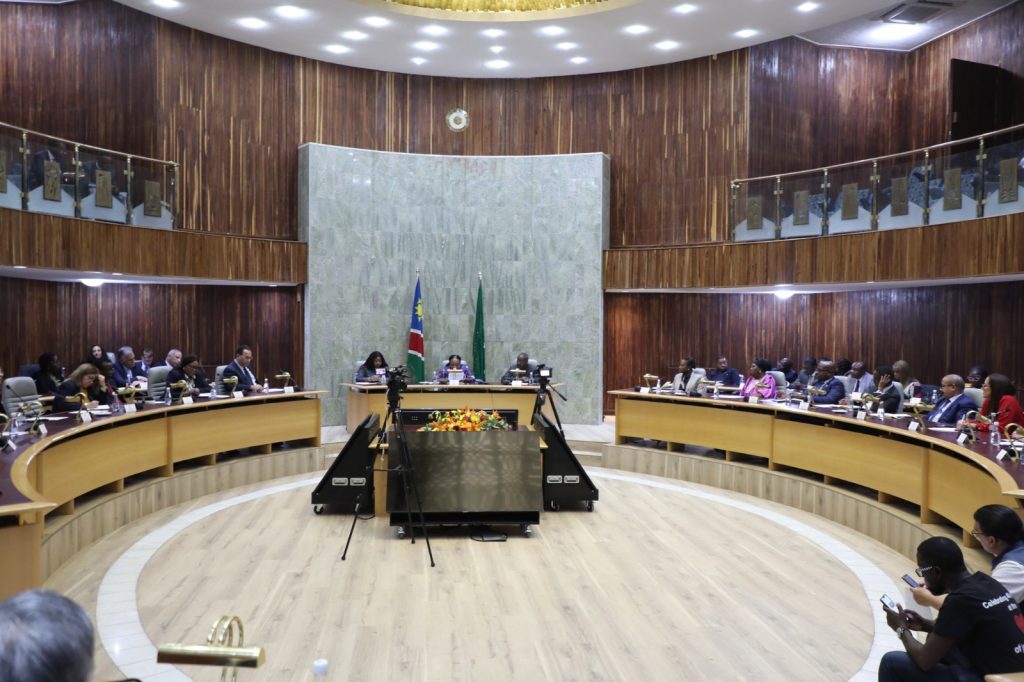
Ashipala-Musavyi made this statement at the recently held Diplomatic Corps Briefing, which is an annual event between the ministry and the various diplomatic representatives of missions in Namibia and in neighbouring nations like South Africa.
“Increasingly and in line with the SDGs, we are all placing the welfare of our people at the centre of our work, by optimising economic diplomacy. Namibia is no different, and this, in most part, informed the decision of the President to merge the portfolios of international relations, trade and investment,” she stated.
The minister outlined that this decision during the early formations of the new administration was to ensure improved coordination of policies related to trade and relations.
“This was to ensure better coordinated synergies in the pursuit of our economic diplomacy, while at the same time promoting regional and continental economic integration and enhancing opportunities offered by the African Continental Free Trade Agreement,” the minister explained.
MIRT has placed the improvement of living standards as a goal, which, according to the minister, will be coupled with the sustained prosperity of Namibians.
“To this end, the current administration has identified seven national development priorities, namely agriculture, sports, youth empowerment, quality education and training, creative industry, quality health and social welfare, and land, housing, and sanitation,” the minister added.
Ashipala-Musavyi reaffirmed that her office will maintain positive bilateral relations with the respective nations that have embassies and consulates in and around the country.
“Our bilateral engagements and cooperation will continue to build relationships and partnerships that will complement Namibia’s efforts to achieve national development priorities, in the areas of agriculture, sports, youth empowerment, and more,” she declared.
According to Namibia’s foreign policy document of 2017, the ministry is responsible for the articulation and implementation of specific foreign policy objectives through identified goals and interests of Namibia.
“In pursuance of the afore-stated, Namibia strives to be sufficiently informed of the regional, continental, and international situations, especially those with direct bearing on its security and economic interests. National interests are ingrained in Namibia’s domestic priorities to create wealth, eradicate poverty, and promote international cooperation, peace, and security,” the policy states.
REINFORCING RELATIONS
Ashipala-Musavyi also outlined that the recent visits to neighbours Angola, Botswana, Zambia, Zimbabwe, and South Africa by President Nandi-Ndaitwah, along with regional visits to Mozambique and Tanzania, were best practices for maintaining friendly relations in the SADC region.
“These visits reaffirmed Namibia’s commitment to maintain and further strengthen the excellent bilateral relations and cooperation, thus reinforcing the importance of peaceful co-existence and good-neighbourliness. The visits also aimed at boosting trade and regional integration,” the minister added.
The Namibian Constitution lays down five fundamental principles, under Article 96, which serve as the guiding beacon in the country’s conduct of foreign policy.
“In terms of the fundamental principles, the State shall endeavour to ensure that in its international relations it: adopts and maintains a policy of non-alignment and promotes international cooperation, peace and security,” states the Constitution.
Moreover, it creates and maintains just and mutually beneficial relations among nations, fosters respect for international law and treaty obligations, and encourages the settlement of international disputes by peaceful means.
In line with this view, the minister indicated that today’s global community is burdened by geopolitical strife.
“We live in an era of unique geopolitics, which calls for effective multilateralism. Ultimately, while the geopolitical context may be challenging, the UN should offer us a unique impetus to rethink the world that the UN Charter envisaged. A world of peace and development,” she added.
According to Ashipala-Musavyi, the country will stand with nations that seek self-determination and independence.
“We shall continue to support and extend solidarity to the heroic people of Palestine and Western Sahara. We call for the lifting of unilateral coercive measures against Cuba, Venezuela, and Zimbabwe to help them implement the UN’s 2030 Agenda for Sustainable Development. No evidence supports Cuba’s presence on the list of state sponsors of terrorism, hence it should be removed,” the minister indicated.