
By: Hee-Dee Walenga
World Cup time is upon us. The increase in the availability of flags and other football-related merchandise in the stores and streets is unavoidable.
Everyone has a “World Cup Special” going on. Shops and street vendors in Windhoek have significantly more European and South American merchandise available than African ones, and I don’t think that’s okay.
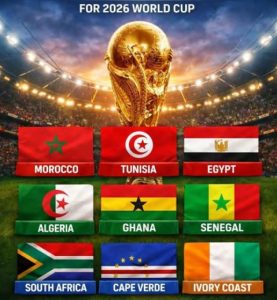
This World Cup has the most African countries (10) participating in it than ever before. The teams are Egypt, Ghana, South Africa, Cabo Verde, Côte d’Ivoire, Algeria, Morocco, DR Congo, Senegal, and Tunisia.
A historic moment for African football. So, why aren’t we celebrating that in an African country (Namibia)?
It’s far easier for me to buy French, German, Brazilian, and Spanish-related merchandise than it is for me to find Senegalese, Egyptian, Ghanaian, and Congolese merchandise.
On the surface, it’s a simple case of supply and demand.
I reached out to journalists from South Africa, Rwanda, Cameroon, Zambia, Kenya, Malawi, and Namibia to gauge if this is a continental problem or a Namibian one.
Let’s start in Namibia. Namibia’s history means that a lot of descendants of Europeans live in the country.
So it’s no surprise that shops and street vendors attempt to cater to them. A street vendor selling flags imported from South Africa in Windhoek told The Villager, “Most of my clients are German and Portuguese. They are the ones who spend money on these things. Africans mostly buy the Brazil and France flags.”
This begs the question: how did we get to a point where Africans are actively choosing to spend money on foreign regalia instead of items representing our brother and sister nations?
What happened to Ubuntu? Agenda 2063? AfCFTA? Pan-Africanism?
“When I was a child growing up during the World Cup, we supported the five African teams until they were knocked out. We have lost Ubuntu and the Harambe spirit,” veteran Namibian sports journalist, Hesron Kapanga, said in an interview with The Villager.
While longtime Namibia Football Association spokesperson, Isack Hamata, explained that retailers and vendors are survivalists.
“Stocking an item that sits on the shelf for months is a financial risk they cannot afford. We (Africans) absolutely love the game, but our support has historically been emotional and transactional rather than structural,” Hamata remarked.
Footy Namibia founder, Silas Tobias, echoed similar sentiments. “For an African, it’s sad, but from a business perspective, the vendors are profiting,” he said.
Hamata also pointed to inadequate infrastructure being an issue. The likes of Adidas, Nike, and Puma that sponsor European national teams have deeply entrenched distribution networks.
“When the World Cup approaches, their global marketing machinery kicks into overdrive, and merchandise flows seamlessly into sub-Saharan Africa,” Hamata added.
Hamata noted that during the Africa Cup of Nations (AFCON), the supply chain for replica jerseys and tournament merchandise is heavily restricted or centralised, making it incredibly difficult for standard retail shops or local street vendors in Namibia to access affordable, authentic African merchandise.
What Hamata alluded to can be explained by the Psychological Continuum Model (PCM).
The PCM is a framework used to explain how an individual develops emotional connections to sports. It consists of four stages: awareness, attraction, attachment, and allegiance. What we often fail to understand in Namibia is that it costs money to move a fan from the awareness stage to the allegiance stage.
There is a reason why you as a Namibian can name more French players than Ghanaian ones.
You are aware of Ghana and DR Congo, but you have an allegiance towards France and Spain because of the millions that have been spent by their leagues and teams to market to you.
“Fans watch these European players week in and week out in the Champions League or the Premier League; the emotional connection and consumer demand are already pre-cultivated,” Hamata concluded.
Senegal
In Senegal, the home of the African Champions (contrary to what CAF may say), the picture looks different, according to journalist Cheikh Demba Ndiaye.
“Here in Senegal, people are selling almost exclusively Senegalese items, such as jerseys, flags, and so on. They aren’t selling products from other European countries,” Ndiaye told The Villager.
Kenya
Over in East Africa, journalist Jeff Kinyanjui told The Villager that there is a healthy balance of the kind of merchandise available to Kenyans, but is not surprised to hear about the situation in Namibia.
“I don’t think it is unique to Namibia. It is easier to watch foreign leagues than it is to watch African leagues. They have done a lot of marketing; the games are easily accessible to watch on TV and online. We have our work cut out as Africans to get there. Progress is being made, but the bottom line is we need to make our leagues better to attract eyeballs,” Kinyanjui expressed.
Rwanda
Sports reporter for The New Times, Dyalan Mugenga, and sports presenter for Station 10 in Rwanda, Elie Baryinyonza, revealed that there isn’t much hype from a commercial perspective in Rwanda.
“Vendors are not selling these flags in Rwanda. But I think that because there are so many African teams in the World Cup, the support from these nations will be high,” Mugenga explained.
Baryinyonza shared the sentiments of his countryman. He also pointed to Rwandans not being happy with the politics surrounding the World Cup as well as the inconvenient time zone, resulting in Rwandans not being emotionally invested in the tournament.
“Kigalians are not happy. They know what’s going on. People are saying this is the worst World Cup that will ever be played,” Baryinyoza explained.
Baryinyoza added that Rwandans show more passion and interest for AFCON.
Cameroon
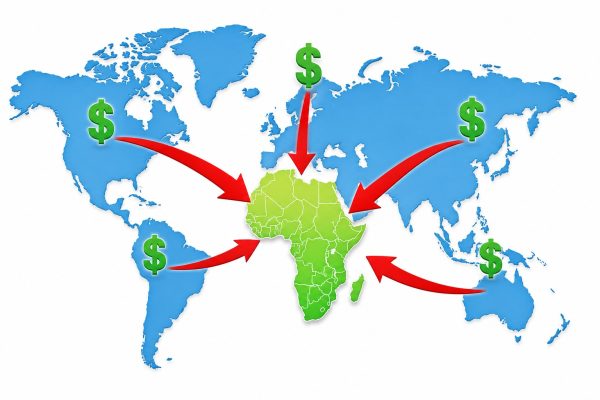
Cameroonian journalist and author, Andre Awoumou, told The Villager that China’s trade agreements with Africa, their ability to produce cheap replicas of European teams in large quantities, and “exploit the passion Cameroonians have for football” is the reason you find more foreign merchandise instead of African merchandise on the streets of Cameroon.
Awoumou also reiterated what Hamata and Kinyanju told The Villager.
“The national championship of Cameroon is not shown on TV. I have been to Namibia. I couldn’t find information about your league on the internet. So what do young people know? They know the European players and teams. Hence they buy these replicas,” said Awoumou.
Malawi
Amin Mussa from the Malawi Broadcasting Cooperation shared that in Lilongwe, Blantyre, and Mzuzu, Malawi’s three biggest cities, “the streets are flooded with European and South American merchandise. Not much African merchandise is available on the streets,” he stated.
Mussa is of the opinion that Africans are discouraged from buying African merchandise because historically, African teams do not perform well at World Cups.
“It seems that Africans have lost trust in African teams. They feel that African teams go to participate and not compete,” Mussa expressed.
“We lack patriotism. Even if you compare the CAF Champions League to the UEFA Champions League, Africans support the UEFA one more. It’s disappointing,” the MBC reporter shared.
Zambia
Nicholas Shingwe, reporter from Bola Ya Kumwesu in Ndola, Zambia, shared with The Villager that Zambia mirrors Namibia.
“European merchandise is all over Zambia. The likes of England and Argentina make more headlines than African teams. I’m not surprised to hear what is happening in Namibia. Football support is about familiarity. Fans can name the starting lineup of England, but if you ask them which South African players they are looking forward to watching, they can’t do it,” the reporter remarked.
South Africa
Founder of the renowned ThamiSoccer blog, Thami Mshengu, explained to The Villager that South Africa is unique in the context of this conversation because of their level of patriotism.
“If you ask a South African what team they support, they will mention a team from the PSL. That’s our culture. We believe in our own teams. Someone rarely answers that question with a European team,” Mshengu said.
Hence, the shelves in South Africa are largely filled with Bafana Bafana merchandise. Most retailers in Namibia are from South Africa, so naturally our shops also have dedicated sections to Bafana Bafana.
To conclude, if we as Africans are serious about developing sports on our continent, then it’s high time that we start putting our money where our mouth is. We cannot blame governments and infrastructure forever.