





By: Kandjengo kaMkwaanyoka
As the call to boost food security enhances, so has the call for foreign investment.
However, there is one aspect of foreign investment that we need to diligently look at and take a stance: how we handle foreign investment or capital deployment in agriculture.
Since the prevailing and dominant literature point to foreign capital as the main driver and exports top the economic agenda, we must be very careful about letting foreign capital dominate our agricultural investment(s).
Reasons for treading carefully with said capital is that one cannot dictate how another party spends or invests their capital. This provides freedom for investors to invest in large hectares of crops such as asparagus, dates and blueberries which cater for the export market, as that is where the big profit margins lie.
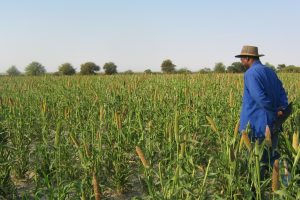
While the foreign revenue flows in, the price of Top Score and mahangu skyrockets, leading us to turn to to India and South Africa for what we produce locally.
The bigger question now becomes: what happened to the huge agricultural investment and handover of various green schemes to the private sector?
An answer would be hard to come by, as one cannot dictate how others deploy their capital, as we will remember.
Foreign capital seeks returns; its mandate is not to solve local food insecurity.
Thus, I caution ourselves and those with the privilege of making economic decisions and resource allocation not to give away green schemes without conditions which benefit Namibians.
Currently, our food reserves/silos are almost empty, but Namibia’s agricultural sector is doing well in terms of exports.
This leaves us with an economic conundrum, do we allocate most of our arable land to feed others and depend on other countries to feed us?
Or is it possible to do both?
Because how do we brag about agricultural revenue when we cannot feed ourselves, and the poorest cannot afford a 10kg bag of mahangu?
It all comes back to what are we investing in within the agricultural sector, whose capital it is, and lastly the motive and mandate of said capital.
Thus, I caution again, we cannot allocate all our arable land to foreign capital or the private sector without conditions on what to produce. Though asparagus, berries, and dates might command higher margins, they aren’t staple foods for Namibians.
And even if we decide to feed the world and neglect ourselves hoping that the export revenue will trickle down to the workers so that they can afford pricey pastas, we know that is not a tangible dream to hold onto.
It is imperative that we get our priorities straight and ensure food security is never compromised, as no investment should make us lower our guards on arable land and the production of staple foods.
The argument here is not to discourage foreign and private sector investment in agriculture, but to ensure the government sees to it that the arable land feeds Namibians.
We shouldn’t be blinded by the glitter of export revenue and seasonal jobs and forget that we are importing mahangu from India to feed the workers.
If we give the green schemes to the private sector where foreign capital will be invited, and we plant export-oriented products, we shouldn’t make long speeches about food insecurity. Nor should we be surprised if Namib Mills increases the price of Top Score, Pepata increases the prices of their oshifima, and fat cakes become ever more expensive.
It has been documented that 60% of Africa is made up of arable land, yet it is the most food-insecure continent.
Why?
Because of how agricultural land is deployed; we have massive farms of coffee, tea, cocoa, tobacco, and berries that are meant for export, while investment in staple foods receives peanuts in investment and support.
A national strategy on achieving food security for all must be at the top of the list for NDP 6. Economic freedom and empowerment start with food security and affordable food. At the centre of affordable and nutritional food is who controls agricultural land and what they are planting.