


By: Dwight Links
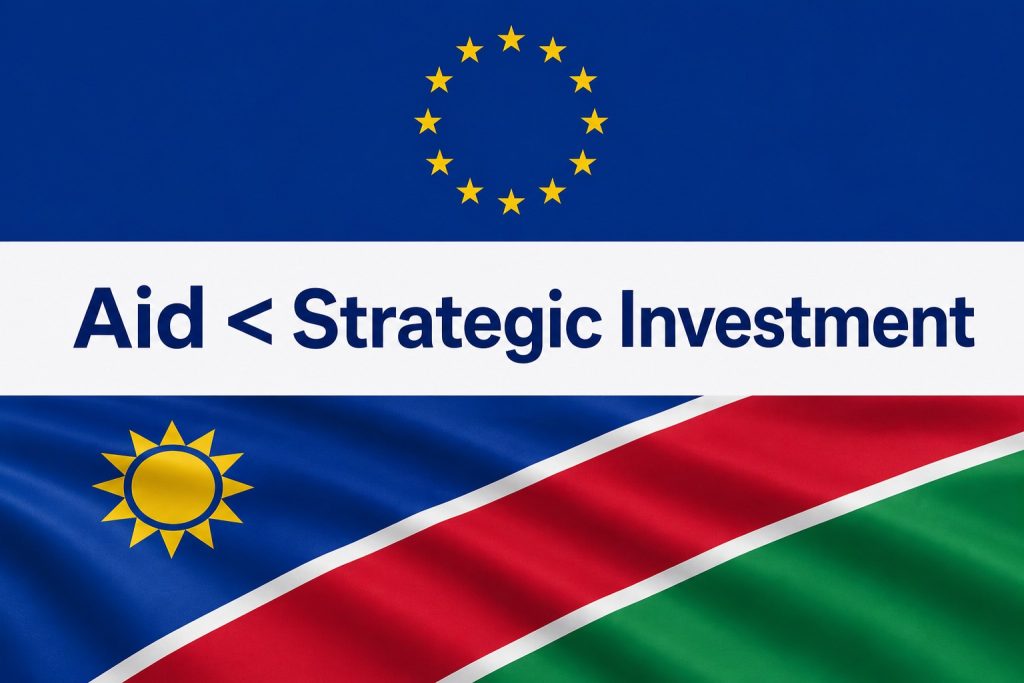
The European Union (EU) Delegation to Namibia outlined that the new Global Gateway program is a quest for improved partnerships based on strategic investment offers, not aid.
The delegation revealed during the just-ended EU-Namibia Business Forum that Europe’s Global Gateway program is the European Union’s answer to mobilising investments at scale.
Alexandre Baron from the EU Delegation to Namibia outlined that in the program’s quest for improved partnerships, “The answer is not aid. But, rather a strategic investment offer, which is built around quality infrastructure, trusted standards and genuine partnerships.”
He made these remarks during a session on the EU’s flagship green program, which sought to explain what the Global Gateway looks like in practice versus on paper.
According to Baron, investment strategies available for partner countries are blended finance, the European Fund for Sustainable Development Plus (EFSD+), guarantees, and concessional lending.
“All these instruments are very powerful, but they are not easy to navigate,” Baron noted.
Moreover, the Namibia-EU Business Forum aimed to showcase what the concept-to-project roadmap looked like, with the Oshivela HyIron Plant in Erongo serving as one of the practical examples put forward at the forum.
Paulus Geraedts from the Secretariat of the External Investment Plan, at the European Commission, outlined that they mostly work with development partners and their development banks on blended finance and guarantees.
“We have signed guarantees with some of the world’s leading development banks, like the KfW, the former EBRD (a bank for Central and Eastern Europe), and some in Sub-Saharan Africa. And these investments allow them to go beyond their risk appetite,” highlighted Geraedts.
On the subject of how the Global Gateway program will be materialised, Geraedts indicated that the program functions as a template to build resilient connections with the world.
“To translate this, the Global Gateway is supposed to be and wants to be our principled based offer – an offer in partner countries to tackle the infrastructure deficit,” Geraedts added.
According to the African Development Bank, such partnerships could translate to billions per year.
“The African Development Bank (AfDB) notes that between $130-170 billion per year is required to fund infrastructure development. In other words, we have a financing gap of up to $108 billion per year because of poor regulatory frameworks and red tape,” stated the United Nations’ Economic Commission for Africa back in 2024.
SDGs AS GUIDING PRINCIPLE
Geraedts added that the Commission is currently in a position to offer infrastructure development financing for the achievement of the United Nations’ Sustainable Development Goals (SDGs).
“We consider many of the countries we work with today as partner countries, and they were in the past known as donor communities or nations,” he remarked.
At the heart of the EU principles, Geraedts said, is the value placed on green and digital transitions for global use.
“This is not about development and charity anymore, but rather about knowing what both parties in the partnership want. And finding equal partners and doing business on a win-win basis,” Geraedts asserted.
EU standards for production and trade, and EU companies and their values are central to the Global Gateway, as it aims to link partner institutions with these elements in trade between the EU and other nations.
“This means that Europe is positioning itself as a credible investment model to competing models. It is not easy to define EU interests, but it is noticeable when it is manifesting,” Gereadts explained.