



By: Helmut Mahongo
The ongoing civil war in Sudan is threatening the Meroë pyramids, a UNESCO World Heritage Site.
The conflict that broke out in 2023 between the Sudanese Armed Forces (SAF) and the Rapid Support Force (RSF) is also threatening one of the country’s UNESCO World Heritage Sites, the Meroë pyramids.
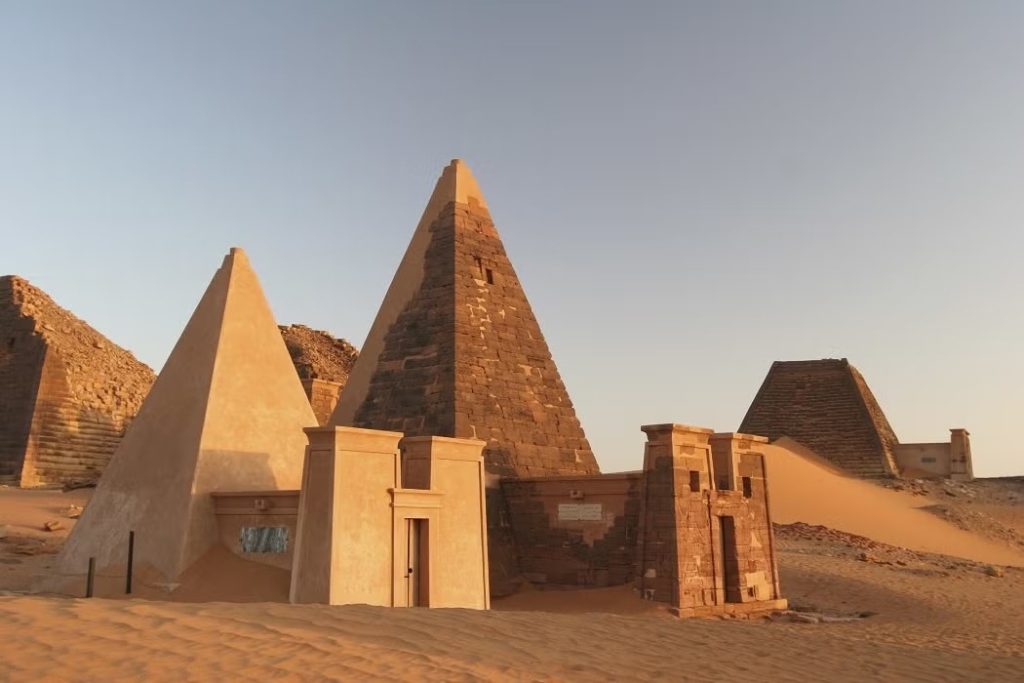
Located just 200 kilometres north of the capital Khartoum is a complex of more than 200 pyramids built between 800 and 300 BC by the Kingdom of Kush.
The Kingdom of Kush was a significant power of the ancient region of Nubia in what is now southern Egypt and northern Sudan.
Archaeologist Mahmoud Suleiman said their deterioration is due to a combination of many “adverse” factors, including climate change, war, and the halting of international preservation efforts as a result of the ongoing conflict, which is not helping matters.
Not one is intact after enduring over 2,000 years of the scorching sun, rain, sand, and wars, with treasure-hunting Europeans blasting some of the pyramids with dynamite in the 1800s.
Estimated to be about 800 years older than the Egyptian pyramids, the Meroë Pyramids were once Sudan’s most visited heritage site.
According to UNESCO, however, by 2018, 15 World Heritage sites were placed on the List of World Heritage in Danger in Africa.
The List of World Heritage in Danger compiles a list of sites that helps inform the international community of conditions which threaten the very characteristics for which a property or site was inscribed on the World Heritage List, and to encourage corrective action.
This was attributed to all kinds of threats from extractive industry activities, armed conflict, acts of terrorism, climate change, poaching, and uncontrolled rural and urban expansions.
The ongoing conflict in Sudan has also impacted the country’s tourism industry.
“Visitors were coming, missions were operating, and everything was fine until the year 2023 and the war,” said Mustafa Ahmed, one of the guards of the Meroë pyramids.
This is a step back in the continent’s tourism industry as it has been showing some significant growth. In July, the World Travel & Tourism Council (WTTC) revealed that Africa is entering a new era of tourism growth, with Travel & Tourism (T&T) outperforming the wider economy and positioning the continent among one of the world’s fastest-growing regions in 2026.
According to 2026 Economic Impact Research (EIR) data of 2026 from WTTC, T&T contributed $12.7 billion to Kenya’s economy, about N$210 billion in 2025, representing 9.3% of national GDP; this also supported 1.8 million jobs, equivalent to 8.3% of total employment.
This dual contribution underlines tourism’s role as both a major economic driver and a powerful engine of inclusive growth. In this report, Kenya emerged as the leading sustainable tourism powerhouse on the continent.
According to the WTTC, Kenya’s success story is part of a broader transformation taking place across Africa, indicating that T&T contributed $228 billion, about N$ 3.7 trillion, to Africa’s economy in 2025, representing 7.0% of regional GDP.
Growing by 5.0%, significantly outpacing the wider economy, which expanded by 3.5%, as well as the global average of 4.1%.
The report also revealed that Namibia is on an upward trajectory in International and Domestic Visitor Spending, showing a rise from N$ 8.3 billion in 2019 to N$ 10.5 billion in 2025, with a forecast of N$ 11.2 billion in 2026 and N$ 12.8 billion by 2036 for International Visitor Spending.
Domestic Visitor Spending also shows an upward trend from N$ 17.3 billion in 2019, N$ 21,4 billion in 2025, and a forecast of N$ 22.1 billion in 2026 and 28.5 billion by 2036.
The WTTC also found that growth is expected to accelerate further in 2026, with the sector forecast to contribute US$241 billion, about N$ 3.9 trillion, and an expansion of 5.4%, making Africa one of the fastest-growing tourism regions globally, alongside Asia-Pacific.
Sudan’s conflict has been going on for over three years and leaves the pyramids standing largely abandoned.
With no end in sight to the war, the harsh desert environment continues to ravage these wonders of the ancient world, proving once again how armed conflict impacts all sectors of not just one country by region’s economies.