






By: Hee-Dee Walenga
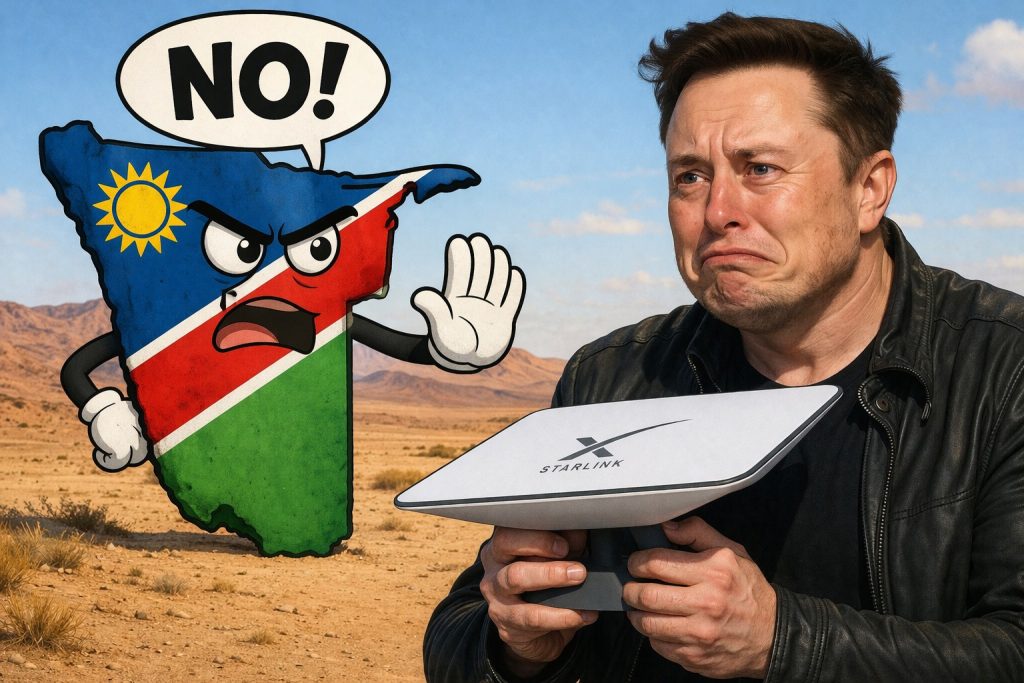
The Communications Regulatory Authority of Namibia (CRAN) officially rejected Starlink’s licence application to operate in Namibia.
Starlink, owned by the world’s richest man – Elon Musk – has been registered under the Business and Intellectual Property Authority (BIPA) since May 2024 and submitted a formal licence application to CRAN in June 2024.
Starlink’s applications to operate in Namibia and South Africa have become infamous, with Musk publicly dubbing the countries’ local ownership regulations – which require 51% local ownership to operate in the country – as “racist,” proceeding to post on X (another platform he owns) that the only reason Starlink is not allowed to operate in South Africa is because he is “not black.”
Minister of Information and Communication Technology, Emma Theofelus, explained that Starlink’s application was evaluated against six prescribed statutory criteria: Competition, Technical and Financial Capacity, Frequency Availability, Ownership and Control, National Defence and Public Security, and Compliance History.
CRAN chairperson Tulimevava Mufeti explained that Starlink only met three of the six criteria, namely Frequency Availability, Technical and Financial Capacity, and Competition. Each criterion not met counts as grounds for refusal.
Ownership and Control
Mufeti explained that Starlink does not comply with the ownership requirements prescribed under Section 46 of the Communications Act, as the entity is wholly foreign-owned. Starlink also failed to obtain an exemption from the statutory obligation mandating a minimum of 51% Namibian ownership.
CRAN stated that Starlink does not adequately satisfy the requirements relating to national defence, public safety, and regulatory compliance.
National Defence and Public Security
Namibia’s data sovereignty was a major point of contention among Starlink detractors. “Starlink’s proposed business model – based on satellite-delivered services with 100% foreign ownership – raises material regulatory considerations concerning jurisdiction, enforceability of compliance obligations, and the ability of the Authority to exercise effective oversight as required under the Communications Act,” Mufeti explained.
Compliance History
Starlink contravened Section 39(3)d of the Communications Act, by operating a network and offering a telecommunications service without a valid service licence. Starlink’s contravention of the Communications Act and failure to respond to the Authority’s summons shows a total disregard for the governance framework of the sector and raised doubt on the company’s ability to honour licence conditions in future.
Of the criteria met by Starlink, Mufeti explained, “Starlink’s business case is expected to enhance competition in Namibia’s telecommunications sector by addressing coverage gaps, especially in areas where terrestrial infrastructure is costly and challenging. Starlink has demonstrated both financial capacity and technical expertise necessary to successfully execute its business case. No technical constraints arose from limited availability of frequencies, as sufficient spectrum exists within the designated frequency band for use by Starlink.”
Theofelus also revealed that in Starlink’s application, the company stated that the once-off cost of its hardware, including shipping, would cost between N$5,000 and N$6,000. Theofelus also revealed that Starlink’s unlimited internet would cost between N$900 and N$1,000.
“Of course this is doable for many sections of our community, but it does not respond to the communities who cannot afford the current cost of data. We did not see a direct correlation that once we approve Starlink, we would achieve 100% connectivity,” stated Theofelus.
CRAN recently approved licences for OneWeb, a UK-based company and direct competitor of Starlink, to provide Low Earth Orbit (LEO) satellite services to Echo Telecommunications, Oblixx Communications Networks, Rocketnet Internet Namibia, and Blue Telecommunications to provide internet access to Namibians.


