


By: Annakleta Haikera
The Deputy Chairperson of the Parliamentary Standing Committee on Education, Youth, Civic Relations, and Community Development, Austin Samupwa, has called for an increase in budget allocation to the education sector to address infrastructure challenges affecting schools.
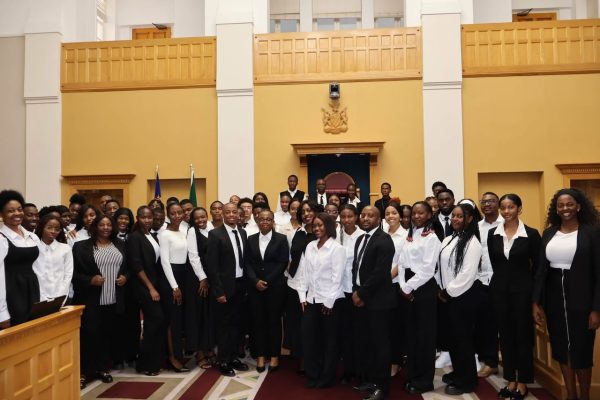
Speaking on Monday during the committee’s oversight visit to five schools in the Kavango East Region, namely the Sauyemwa Junior Primary School, Augustinus Mashika Secondary School (previously Ndiyona Project School), Pikinini Junior Primary School, Edward Muhoka Senior Secondary School, and Mutjiku Junior Primary School, Samupwa said the situation in these schools reflects the urgent need for government intervention.
Speaking to the progress of Augustinus Mashika SS, Samupwa shared that the new project school was established to decongest Ndiyona Secondary School, where some classrooms accommodate more than 65 learners; a situation he described as unhealthy and hindering effective teaching and learning.
He implored the government to fast-track the completion of the school to cater for over 300 learners, noting that the four classrooms currently available are insufficient. Samupwa also pointed to the school’s lack of an administration block, while the toilets are still not operational, stressing that these issues required immediate action to ensure learners have a conducive learning environment.
He acknowledged that the country faces several infrastructure and resource challenges in the education sector, which cannot be resolved in a single financial year.
“There are quite many, and we cannot eradicate them in one financial year,” he said.
“But with sufficient allocations and proper planning, I foresee that we are going to overcome these challenges,” he added.
On a more positive note, Samupwa commended teachers for their resilience and creativity in the face of limited resources.
“The most basic resource in a school is a teacher. They use their knowledge and dedication to make many things happen, even when there are not enough desks or teaching materials. We have seen them go out of their way to supplement what the government provides,” he lauded.
Adding to the challenges of the education sector, Sauyemwa Junior Primary School principal, Regina Haingura, revealed that recent strong winds blew the roofs off of the school’s administration block and two classrooms. Haingura said the school currently has 34 classrooms, which are not enough to accommodate its 1,777 learners. As a result, some learners attend classes in two shifts – morning and afternoon – leaving many children tired and hungry.
She added that although four classrooms are under construction with support from the Japanese Embassy, the school still needs at least 12 more to ensure all learners can attend lessons in the mornings.
Echoing school overcrowdedness, Ndiyona Circuit Inspector of Education, Pontianus Kamunima, stated that the conditions at Ndiyona Combined School also force Grade 10 and 11 learners to attend classes in the afternoon. He added that some learners arrive intoxicated, while others skip classes or struggle to concentrate due to fatigue or hunger.
As a result, Kamunima indicated that teachers are compelled to combine multiple grades in one classroom to create space for other learners to attend school.
Ndiyona Combined School currently has over 1,000 learners from pre-primary to Grade 11.
Meanwhile, at Pikinini Junior Primary School, the situation is reportedly equally as dire. The school has no toilets or teachers’ accommodation, and learners are still taught under half-constructed iron sheet structures.
It is said there are only four teachers at the school, with one teacher handling multiple grades (grades 1 to 3), and other colleagues having to work on weekends to complete their lessons as a result of the overwhelming workload.
The committee is set to continue its site visits to various schools, including those in the Zambezi Region until Thursday.