




By: Nghiinomenwa-vali Hangala
The National Council Committee on Transport, Infrastructure and Housing has declared the country’s road accidents a national public-health, socioeconomic, and development crisis.
The Committee has also attributed driver behaviour as the main cause of accidents.
From 2024 to mid-2026, the country has recorded 3,020 crashes that caused 2,330 serious injuries.
The Committee stated this in its report after engaging stakeholders across the 14 regions on how the country can combat road accidents.
The engagement was intended to find practical, measurable, and accountable interventions.
According to the Committee’s findings,’ reckless driver behaviours include overtaking, speeding, alcohol impairment, fatigue, and disregard of traffic laws.
The Committee added that drivers’ behaviours are not isolated from the current infrastructure, vehicle roadworthiness, public transport laws, and institutional coordination.
It has also highlighted that the repetitive behavior across regions is evidence of institutional weakness.
These include shortage of traffic officers, enforcement equipment, poor pedestrian facilities, inadequate signs and lighting, animals on the roads, and road quality.
The Committee has also found regional distinct risks requiring targeted responses.
These include livestock and wildlife risk in rural corridors; freight pressure in Erongo and Otjozondjupa; and B1 Corridor fatalities in Hardap and //Karas.
• Domestic animals accounting for 51% of accidents recorded in Kavango West
• Pre-hospital hospital challenges in Kunene Region
• Inadequate non-motorised transport infrastructure in Ohangwena Region
• Heavy cargo pressure in Kavango Region
The National Council Committee has recommended a country-wide approach involving government and society to address road accidents, terming it the ‘whole-of-government and whole-of-society approach.’
Adding that the approach will be anchored in legislative reforms, strong law enforcement, intelligent traffic management technology, road infrastructure; dualisation of accident-prone roads, and widening of roads across the country.
“This should be complemented by continuous public education, professionalised driving training, improved emergency medical response, integrated and reliable accident data systems,” the Committee wrote.
They also suggested stronger institutionalised accountability to ensure coordinated and measurable actions towards reducing road crashes and fatalities.
Road crashes have increased significantly in 2026, exceeding 2024 (577) and 2025 (538) levels.
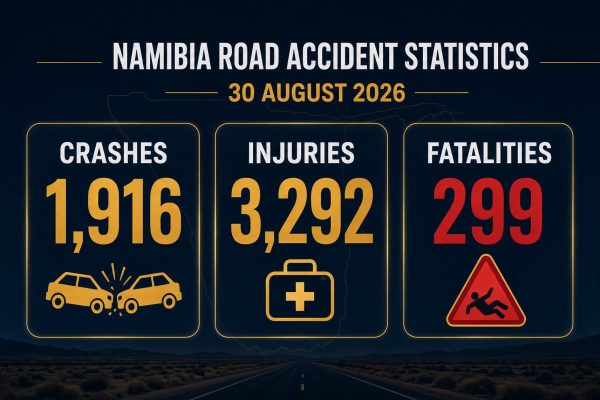
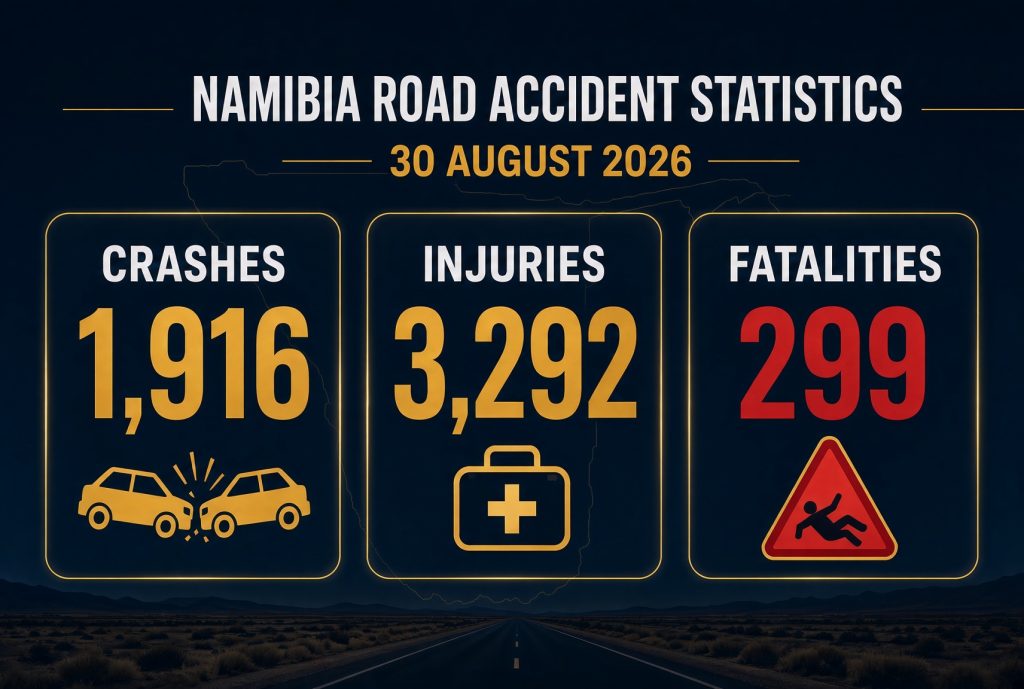
Year-to-date (August 2026), the country has recorded 1,905 road crashes, causing 3,592 casualties and, and 304 deaths.
According to the Committee, the road crash statistics indicate a persistent road safety crisis in Namibia, with fatalities and injuries.
“The available national statistics show that road crashes remain a major public health safety concern, with fatalities and serious injuries continuing to place considerable burden on families, communities, the health system and the national economy,” the Committee wrote.