

By: Hileni Inane
A group of Namibian Media and Think Tank Representatives attended a workshop in Shanghai between 29 June and 3 July for a people-to-people exchange programme through the Foreign Affairs Office of the Shanghai Municipal People’s Government.
The programme aimed to provide cultural experiences, China’s 15-year plan insights as well as Shanghai’s economic mode of development.
Through this visit, the Namibian delegation was able to attend lectures on the 15-year plan, which gave a differentiating insight into how presidential terms are planned and executed in comparison to Namibia’s governing styles.
The delegation was able to visit and learn about the Mandates of the Chinese People’s Political Consultative Conference (CPPCC), which is a political advisory body in the People’s Republic of China and a central part of the Chinese Communist Party’s united front system.
Its members advise and submit proposals for political and social issues to government bodies to execute the long-term plans.
The CPPCC holds the government accountable and ensures that the long-term economic plans and the needs of the people are carried out.
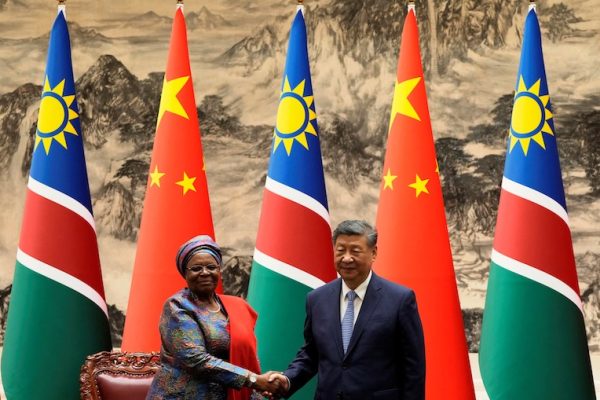
Speaking at the opening ceremony, Wang Xin, the Vice President of Shanghai International Studies University (SISU), said that their work, comprehensive strategic partnership and the ample years of cooperation on the joint development of the Belt and Road, China-Namibia relations continue to enjoy sound and steady development.
Political mutual trust has deepened, and practical cooperation has delivered economic results.
Wang emphasised on the importance of the 36th anniversary of diplomatic relations between China and Namibia, as well as the 26th anniversary of the Forum on China-Africa Cooperation (FOCAC).
At this important juncture linking the past and the future of shared history, the Africa-China dialogue summit consensus is rapidly changing from a shared vision into solid action, injecting fresh intellectual strength into China-Africa relations.
Wang spoke of the importance of collaboration and said the Shanghai International Studies University (SISU) was founded in 1959 for the integration and understanding of foreign languages, to learn and understand partnerships in local languages.
SISU is one of China’s earliest institutions specialising in foreign language education and international studies, currently offering instruction in as many as 54 foreign languages, including every major language such as Russian.
The university has established partnerships with more than 490 universities, institutions, and international organisations across 69 countries and regions, aiming to add more foreign languages to the current language offering they have.
As a result of this visit, Okahandja Town Council Mayor, Ileni Mutumbulwa, and Town Council Chairperson, Patricia Hawaes, were able to sit with their sister city representatives led by Liu Zhongyan, the deputy Town Mayor of Maqiao Town People’s Government in Shanghai, and revisit conversations of a dormant sister city Memorandum of Understanding (MoU) that was signed in 2012.
The MoU is established to strengthen agricultural exchange and business and trade initiatives and an exchange of cultures. The two parties agreed to continue talks to review the MoU and work towards renewed goals to the benefit of both towns.
At a separate site visit to Hongqiao 365 Hub, the Namibian delegation learned about the facility, which is established to help foreign countries market and showcase their products in China.
Hongqiao 365 Hub consists of livestreaming services for product marketing, coffee and exhibition stands.
Manager of the Department of Supply and Chain at the Hub, Guang Lin Li reminded the delegation to take advantage of the launched zero-tariff policy for eligible products from African countries.
From 1 May 2026, qualifying Namibian products exported to China can enjoy zero tariffs for a period of two consecutive years. However, there are some important conditions, such as certain products subject to tariff-rate quotas, such as wheat, rice, and other grain products.
Imports that fall within the quota qualify for zero tariffs, while imports beyond the quota are subject to the normal tariff rates.
Secondly, some categories of goods remain prohibited or restricted by the Chinese government. These include products such as weapons, illegal drugs and narcotics, which are not permitted for import. In addition, endangered wild animals and plants, and products derived from them, are also prohibited from being imported.
He spoke about their understanding of Namibia and its products such as baobab oil and baobab powder, through the China International Import Expo (CIIE).
GuangLin hopes that Namibia can showcase more new products at the China International Import Expo (CIIE) that’s scheduled to take place from 5-10 November 2026 at the Shanghai International Exhibition Center.
Namibian products can also be introduced onto the Hongqiao 365 platform.
Adding that the goal is to extend the opportunities created during the six-day expo into 365 days of year-round promotion, helping more Namibian products enter the Chinese market.
The delegation visited AI, humanoid, and study robot centres, which revealed the difference in study opportunities and the role AI will play in the future, especially for the Chinese market.