



By: Peneyambeko Jonas
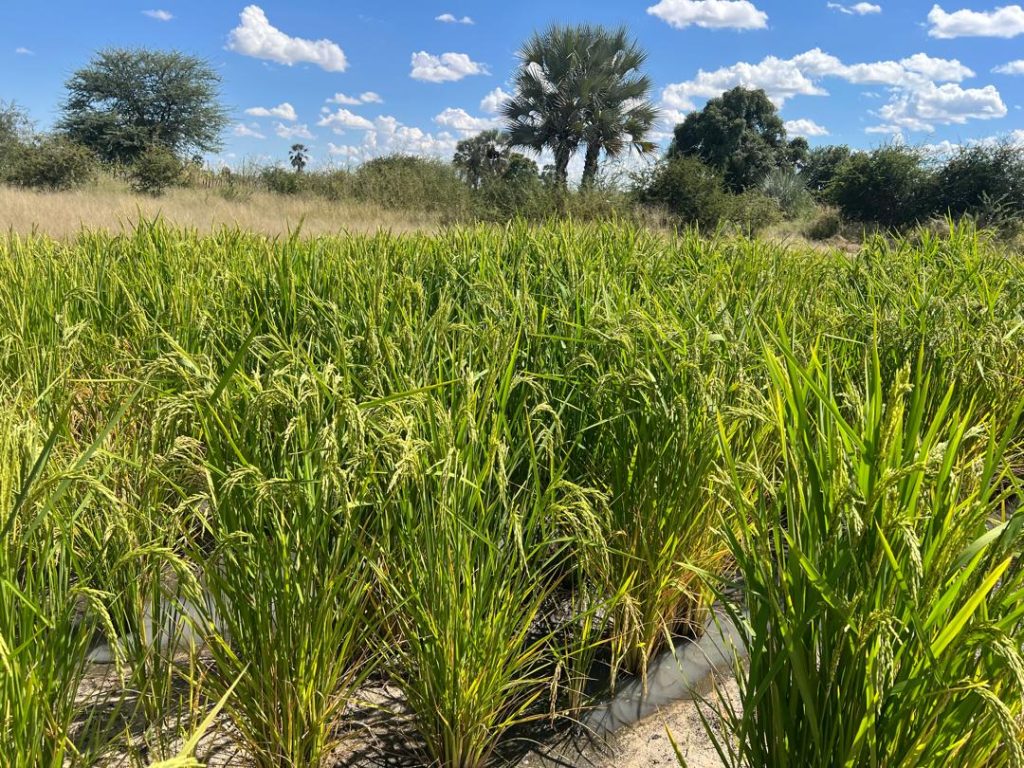
Rice production in the Oshikoto Region is steadily gaining momentum, with farmers in local villages expressing optimism about improved yields following recent support and equipment donations.
This week, Eagle Media House engaged several local farmers who are now anticipating a strong harvest season by June 2026.
Samuel Amunyela, a rice farmer from Elombe Village who began his journey in 2018, shared his experience of gradually building his production capacity.
Starting on a small portion of land, Amunyela has expanded his farming activities through persistence and learning.
Reflecting on his journey, he said, “From birth, I believe I am a farmer, but rice production is something I have learnt because I believe that it will be helpful to feed my family, just in case mahangu and other products don’t give us a good harvest.”
Despite his progress, Amunyela pointed out that irrigation remains one of the biggest challenges in rice farming.
He emphasised the importance of water availability and proper machinery, especially when working on waterlogged fields.
“Rice production can only be achieved if there’s enough water, but it is very difficult to plough on that portion that has water without proper farming equipment,” he explained.
His remarks came as he received rice production equipment donated by Debmarine, aimed at easing such challenges.
In Enkono Village, another farmer, Vaino Namushinga, expressed appreciation for the donated water pump, describing it as a game-changer for his farming operations.
He explained how he previously relied on manually collecting and storing water for irrigation.
“Lately, I dig a hole of water aside as I collect water from the lake and keep it there for my rice production, just in case the rain stops. But now that I have a water pump, I am even thinking of extending my farm,” he said.
Namushinga further revealed that he expects his rice to be ready for harvest by June, estimating a yield of two 25-kilogram bags.
However, he raised concerns about potential threats to his crop, particularly from grazing animals.
“The only challenge I have at the moment is the fear of my rice plants being grazed [on] by animals, but I am confident that I will put up a fence to protect the farm,” he added.
Festus Amunwe from Oniimwandi Village also shared his positive outlook on rice farming, noting significant improvements compared to the previous year.
Despite facing discouragement when he first started, he remained committed to the venture.
“Even though last year there were a lot of discouragements when I started, it didn’t stop me from farming rice,” he shared.
Amunwe highlighted the reliability of rice as a crop, especially when compared to traditional staples.
“I farm other things like tomatoes, sweet potatoes, and vegetables, but rice production really pushed me because it never stops producing. Rice gives harvest after harvest, unlike mahangu, which every homestead relies on, and this will help me feed my family,” he explained.
However, he also acknowledged challenges such as pests and environmental factors.
“In rice production, we face challenges like spider webs covering our rice, which makes it very difficult to harvest, and birds also eat the seeds. But that will never stop the production,” he remarked.
Among the farmers, Saima Iyambo from Oniiwe Village stood out as the only female rice producer in the group.
As a newcomer to farming, she expressed enthusiasm and determination to succeed.
“This is my very first farming project, but looking at the production, I do not regret the journey I took. I am looking forward to a good harvest in June,” she said.
Providing technical insight, Professor Simon Awala from the University of Namibia’s Ogongo Campus, who has been training the farmers, stressed the importance of a consistent water supply in rice production.
“If the land dries, the seeds will not germinate and grow, and that is why water pumps have been donated to help farmers pump water from lakes and rivers into their fields,” he explained.
He added that rice can grow within a relatively short period under proper conditions, stating that “it only takes one month for rice to grow.”
Awala further cautioned against relying solely on rainfall, noting its unpredictability.
“Farmers cannot depend on rainwater as it dries out easily, but the water pump will be very useful in generating water from lakes,” he said.
Officials from the Ministry of Agriculture, Forestry, Water, and Land Reform in the Oshikoto Region were also present during the visit, facilitating the distribution of donated equipment.
The initiative is expected to strengthen local agricultural productivity, enhance food security, and empower farmers through sustainable rice production.
With renewed hope, improved tools, and growing expertise, rice farmers in Oshikoto are positioning themselves for a productive season ahead.
As of the 4th Quarter of last year, Namibia’s import bill for agronomy products such as wheat, maize, and mahangu was N$488.0 million.
The country does not track the production of rice at this stage, with only small-scale production and trials around some regions.