


By: Hee-Dee Walenga
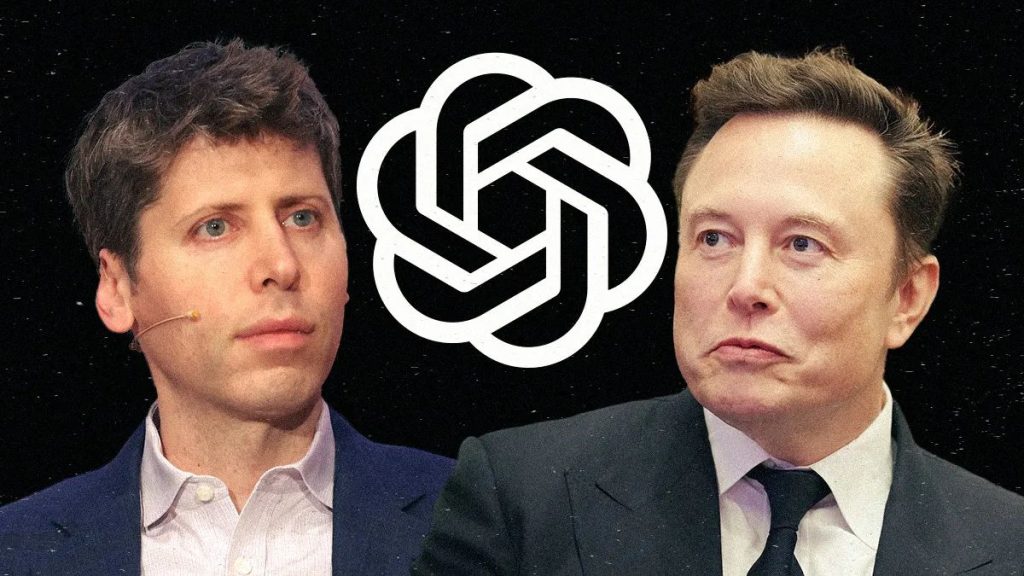
Elon Musk & Sam Altman launched OpenAI as a non-profit in 2015. The goal was to bring artificial intelligence (AI) to the masses and keep the potential dangers of it out of the hands of a single company.
Fast forward a decade later, the two are now involved in a legal battle – which began last week in a federal courtroom in California – that could drastically change the AI landscape.
Musk claims that Altman duped him into investing US$38 million under the guise that the company would run as a non-profit and develop AI safely and transparently for the benefit of humanity.
“They wouldn’t exist without me. I created the name. ‘OpenAI’ refers to open source. I was instrumental in recruiting the key scientists and engineers of OpenAI,” Musk said in an interview. He likened the company’s for-profit transition to that of a company founded to save the amazon rainforest turning into a lumber company.
“Elon donated $38 million to the OpenAI non-profit, which was spent exactly as intended and in service of the mission,” OpenAI published in a statement.
Following Musk’s exit from the company in 2018, Microsoft invested US$10 billion in OpenAI in 2022 and ChatGPT was launched. Since then, the tech tycoons have been involved in a legal and public spat. Musk sued Altman, Open AI, and Microsoft in 2024 and is currently seeking more than US$100 billion in damages, the removal of Altman from the OpenAI board, and the return of OpenAI to a non-profit business. “You can’t just steal a charity,” Musk repeated on the stand.
Power seems to be at the heart of the feud, with Altman claiming that Musk regrets leaving the company early and wanted to take control of the business and commercialise it himself. Musk has since opened his own AI company, xAI, the company behind Grok, the AI chatbot integrated into X (formerly Twitter).
Musk and a group of investors reportedly tried to purchase the non-profit entity, the OpenAI Foundation, which legally controls OpenAI, for US$97.4 billion in 2025. Altman rejected the offer on X and offered to buy X for US$9.74 billion instead. Musk revealed on the stand that xAI uses OpenAI models to train its own technology.
The case will be presided over by judge Yvonne Gonzalez Rogers, who has dealt with several high profile tech cases in the past, such as the Apple vs Epic antitrust case. The trial will be three weeks long.
OpenAI and xAI are both intending to go public later this year, each in the US$1tn valuation ballpark.
Should Africa pay attention to this case?
Namibian tech entrepreneur and founder of Gemsweb Digital, Ati Iigonda, believes that the abundance of alternatives when it comes to AI companies means that the case won’t have a direct impact on the AI landscape in Africa.
“There are hundreds of others, and frankly some that outperform ChatGPT,” he told The Villager.
However, Iigonda stated the case is of importance to Africa because it could impact how companies in Africa’s growing AI space are shaped and governed. “The principle matters regardless of geography, and Africa is not exempt from that conversation,” he said.
Member of the AI Technical Advisory Committee (TAC) at the National Commission on Research, Science and Technology (NCRST), Dan Mayonde, echoed Iigonda’s sentiments. “Africa would be indirectly affected. OpenAI isn’t the only company out there,” he told The Villager.
Mayonde stated that OpenAI being the non-profit open source entity that Musk is suing for would help African countries such as Namibia, as it will allow African engineers to use OpenAI models to develop their own systems.
“They can also turn to Chinese models, which are often open sourced,” Mayonde stated. He is of the opinion that OpenAI cannot afford to be a non-profit, for they ought to return the billions invested into the company.
“It’s a lesson to Africa. Africa does not own its data. It shows how vulnerable we are. A foreign case can impact African businesses, AI strategies, and general AI systems,” he cautioned. Mayonde went on to explain that African countries heavily reliant on OpenAI for national operations do not have any say in the decisions made by the company.
In October 2025, the company launched ChatGPT Go, a low-cost subscription plan designed to make its AI tools more affordable and accessible to users. The product was only made available to a select number of African countries, including Nigeria, Morocco, Egypt, Kenya, and South Africa.
In January, the Gates Foundation and OpenAI partnered on a US$50 million project titled Horizon1000, set to help African countries use AI to improve their health systems and reduce the impact of international aid cuts.
Rwanda was the first country to adopt it. “We aim to accelerate the adoption of AI tools across primary care clinics, within communities, and in people’s homes. These AI tools will support health workers, not replace them,” Bill Gates published in his notes.
OpenAI recently announced a partnership with Kenyan tech firm WildMango to expand access to advanced AI technologies across Africa. The partnership will seek to increase access to OpenAI products, adapting applications to African use cases and equipping enterprises and developers with tools to build AI-driven solutions.
OpenAI has infamously outsourced African labourers earning less than $2 per hour, to accurately label data as harmful by making workers watch, read, and listen to harmful and gruesome content for hours on end.
Emmanuel Lubanzadio, a German national with Congolese roots, was appointed as the Africa Lead at OpenAI in 2025. “OpenAI’s mission is that AI benefits all of humanity, and if we are true to the mission, it needs to include Africa,” he said at this year’s Addis AI Forum.