



By: Loise Shiimi
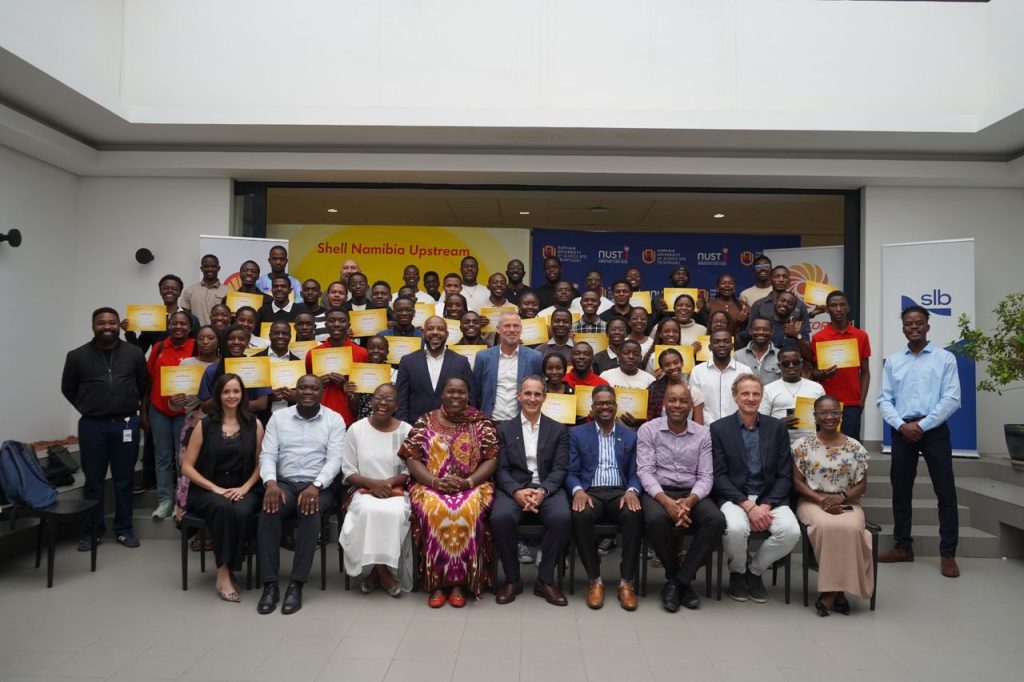
The Namibia University of Science and Technology (NUST) recently recognised approximately 50 engineering students with certificates for their successful completion of a technical workshop titled ‘Introduction to Petroleum Geoscience.’ This initiative was made possible through collaborations with Shell Namibia Upstream B.V. and its partners.
This qualification centres on the practical application of geological and geophysical principles for the exploration, evaluation, development, and management of subsurface energy resources. It serves to bridge the gap between fundamental earth sciences and the technical requirements of the oil and gas industry, with a growing focus on the energy transition.
NUST describes this programme as a means to cultivate local expertise in the oil and gas sector by enhancing the skills and capacities of Namibians. The university highlighted that the strength of this industry lies in its diversity and the synergy it creates.
During the awards ceremony, Eduardo Rodriguez, Shell Namibia Country Chair, encouraged students to embrace hard work and discipline, envision the bigger picture, and not fear failure, explaining that these attributes are essential for finding their footing in the industry.
Additionally, Elsie Kambala, Country Manager at SLB Namibia, urged students to surpass their perceived limitations. “Your background should not hold you back, but rather serve as motivation. The sky is not the limit,” she stated.
Looking ahead, NUST affirmed that in its third training intake, the partnership will continue to play a crucial role in providing Namibian students with foundational knowledge in petroleum exploration competencies for the country’s burgeoning oil and gas sector.
Colin Stanley, the Deputy Vice-Chancellor for Research, Innovation, and Partnerships at NUST, emphasised the significance of sustained collaboration between academia and industry.
“In a rapidly transforming global energy landscape, such partnerships ensure that our graduates are not only academically equipped, but also ready for the industry, adaptable and competitive,” he remarked.
Stanley added that this partnership demonstrates the potential of academia-industry collaboration in shaping forward-thinking graduates who can drive innovation and sustainable development.
The latest cohort comprised students from five engineering disciplines: Mechanical, Civil, Mining, Chemical, Electrical, and Industrial Engineering, all from the Faculty of Engineering and the Built Environment.
Matias Matias, a third-year engineering student at NUST, reflected on his experience over the past five days, noting that the workshop allowed him to engage with industry experts and gain valuable insights into the expectations of future engineers.
“The workshop also fostered collaboration, enabling us to network and work closely with fellow students while completing assessments and assignments,” he added.