




Dwight Links
Through the launch of the Horizon Europe and EURAXESS initiatives, the European Union (EU) is expanding research funding programs offered to Namibian academics and researchers undertaking various projects.
EU deputy head of mission in Namibia, Ian Dupont, noted that the funding mechanisms of Horizon Europe and EURAXESS are aimed at showcasing the vast array of opportunities within research. One such funded project is the Ignite project, which is collaboratively administered by NUST, NIMT and other stakeholders to upscale skills and work directly with green transition entities such as Hyphen Namibia.
“Through the Global Gateway investment package, the EU supports Africa’s higher education and research. Initiatives such as the above-mentioned, Erasmus Plus, and the Inter-Africa Mobility Scheme provide multiple opportunities for African academia,” highlighted Dupont.
According to Dupont, these programmes aid in retaining talent at African universities in order to support growth and development on a broader scale, adding onto the benefits of a strengthened Namibia-EU partnership.
“This is a partnership that supports Namibia’s goals for a green industrialisation, which creates jobs and would position Namibia as a leader in global research in the green transition,” Dupont added.
He emphasised that successfully achieving such a position would depend on the education levels and vibrancy of the research community in the country. Another notable development Dupont made mention of is the Africa Millimetre telescope installation at Gamsberg Mountain outside Windhoek. This initiative, in collaboration with UNAM, will allow Namibia to participate in black hole observation from the southern hemisphere, as the country shares favourable viewing locations with Chile and South Africa.
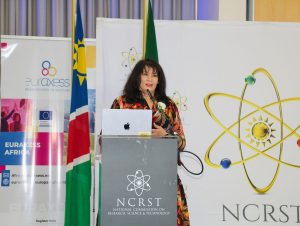
Noting that science diplomacy is a unique platform that strengthens research between nations, Dupont stated that Namibia’s own National Commission on Research, Science & Technology (NCRST) will be the designated partner coordinating the opportunities in the various research programs.
According to the NCRST, the partnership with the EU allows for the advancement of science, technology and innovation cooperation between Europe and Africa, under the auspices of the AU-EU partnership.
In the Namibian context, one of the main focuses is on climate-resilient agriculture, water security, and climate change. NCRST CEO Anicia Peters shared that a report outlined that the country spent 0.73% of the GDP on overall research and development.
“In that, we framed national programs as a structure. These are guided by principles, as we cannot speak of priorities in terms of research. Because we are also talking about how we are funding and building capacity,” Peters indicated.
In terms of ramping up the capacity development of researchers in the country, Peters indicated that the necessary skills and knowledge bases exist. But, not enough of them are available to expand on various undeveloped areas as a result of a lack in infrastructure components.
The NCRST notes research in energy and waste solutions are a priority in the advancement of renewable energy and fostering a circular economy. Food and nutrition security, and the application of artificial intelligence in various sectors such as health also fall under the list of priorities for Namibian research, indicated the NCRST.