



By: Annakleta Haikera
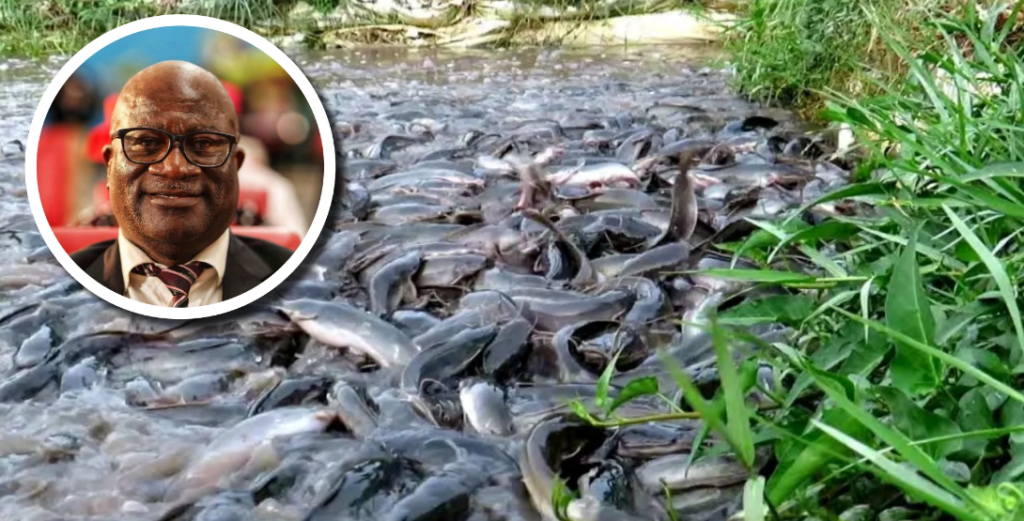
Kavango East Region governor, Julius Hambyuka, says fish farmers in the region are facing daunting challenges due to a shortage of fish feed, which is mostly sourced from outside the country.
Hambyuka made these remarks on Monday while visiting three fish farming projects across the region, where he held joint meetings with groups of farmers, as well as separate one-on-one engagements to better understand their individual operations, challenges and support needs.
He said the idea for these visits came after realising that despite Kavango East being located along a permanent river with abundant fish resources, the region cannot solely rely only on river fishing and must strengthen fish farming to ensure a consistent supply.
According to Hambyuka, fish farming will enable easier access to fish, unlike river fishing where catches are not guaranteed. He added that fish ponds allow farmers to harvest within a short time when there is demand from households, restaurants and visitors to the region.
During the engagements, farmers raised concerns about the high cost and unavailability of fish feed, which they previously sourced from Zambia.
Hambyuka said since 2024, farmers have struggled to access feed, negatively affecting production. He advised farmers to explore local alternatives in the short term while government and stakeholders look into the possibility of producing fish feed locally.
The governor highlighted delays in accessing fingerlings, saying the current procurement process is too lengthy, with farmers sometimes waiting until later in the year despite having ready ponds, water and fencing. To that, he said fish should be availed throughout the year to allow farmers to start production without unnecessary delays.
So far, six fish farming projects in the region are operational and expected to begin sales between February and April. Several others are at preparatory stages, and with the necessary support the region could have up to ten or eleven functional fish farms by the end of the year.
In addition, Hambyuka encouraged farmers to improve marketing, saying the market for fish in Kavango East is readily available, but producers are operating “in silence.”
He urged them to promote their products through the media, pamphlets and direct engagement with buyers, and to consider appointing dedicated marketing personnel. He stated that once production and marketing improve, fish farming has the potential to become a key economic activity in the region while improving livelihoods for local communities.
Sophia Haingura, a fish farmer at the Mbambangandu Fish Farm said fish feed, normally imported from Zambia, has been unavailable since the fisheries ministry merged with the agriculture ministry, a change she says caused procurement delays and disrupted the supply of subsidised feed to farmers. She added that prices at private suppliers have risen to about N$1 500 per bag, making it difficult for farmers to sustain their ponds, placing the local fish supply at risk.
Meanwhile, at the David Johannes Van Zyl Fish Farm, six ponds measuring approximately 70 by 25 metres have been completely filled with rainwater and currently hold an estimated 10 000 fish, most of which are still small.
Van Zyl said he employs local people, mostly women, due to their flexibility and active involvement in harvesting fish for sale at local markets. He added that the recent rainfall has noticeably improved water levels, creating favourable conditions for fish growth and reducing the need for additional water supply.
According to information obtained by The Villager, fish farming in Kavango East has shown steady growth over the past few years as part of efforts to improve food security and diversify income for rural communities.
The presence of the perennial Kavango River provides favourable environmental conditions for aquaculture, while government and development programmes have been encouraging small-scale pond construction and training for local farmers.
However, the sector remains constrained by limited access to affordable feed, fingerlings, technical support and formal markets. Despite these challenges, local farmers continue to invest in fish farming, with increasing interest from youth and women. The activity is gradually becoming an important complementary livelihood alongside crop production and livestock farming in the region.