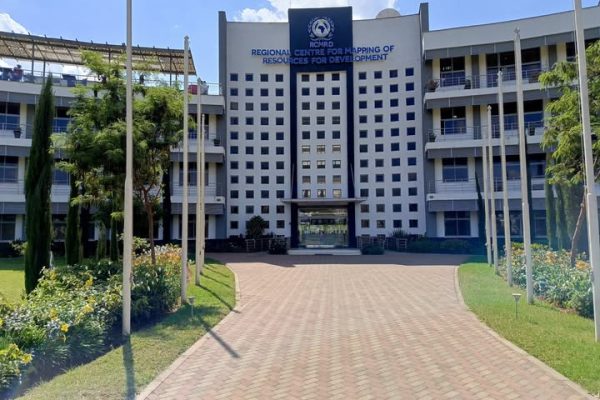




Photo: Regional Centre Training Institute – RCTI
By: Peneyambeko Jonas
Agriculture Minister Inge Zaamwani-Kamwi-Kamwi has called for greater financial independence for the regional institution, warning that reliance on donor funding could affect its ability to deliver essential services to member states.
She was speaking at the 14th Regional Centre for Mapping of Resources for Development Conference (RCMRD) of Ministers in Swakopmund on Monday.
The RCMRD is exploring new revenue sources, including expanded training programmes and direct government contracts, to strengthen its finances and support its work in surveying, mapping and geospatial technology.
These services are important for economic planning, agricultural production, land management, infrastructure development and investment decisions across the region.
The financial sustainability issue featured prominently during the 60th Governing Council meeting held in Swakopmund from 12 to 13 November, where representatives from 15 of the Centre’s 20 member states reviewed its performance, finances and plans for 2027.
Namibia has assumed leadership of the regional institution after being unanimously elected Chairperson of the RCMRD Governing Council for 2026–2028, taking over from Zambia.
Namibia also assumed the chairpersonship of the Conference of Ministers, led by Zaamwani-Kamwi.
The appointments place Namibia at the head of the centre’s two key governance structures responsible for guiding its regional policy direction and institutional oversight.
Namibian Surveyor-General Ndilipunye Shanyengana was also elected Chairperson of the Technical Committee, while Burundi was elected vice-chairperson.
Zaamwani-Kamwi said Namibia’s leadership would focus on strengthening the centre’s finances, building technical capacity in member states and improving collective engagement with international organisations and development partners.
She urged member countries to pay their contributions in full and on time and to make greater use of RCMRD’s services through direct contracting.
The Governing Council approved the centre’s 2027 programme and budget, subject to alignment with its 2027-2030 Strategic Plan, which was presented for consideration at the ministerial conference.
The centre received a clean audit opinion for 2025.
However, the Finance Committee noted that heavy dependence on project funding exposes RCMRD to changing donor priorities and funding conditions.
It recommended expanding training programmes and encouraging governments to directly purchase the Centre’s services as alternative sources of income.
The Council also called for member states to explore joint negotiations with international organisations and technology suppliers through RCMRD.
The approach is intended to strengthen their collective bargaining position when sourcing products and services.
For Namibia, the economic value of geospatial technology is particularly important in addressing drought, land degradation, food insecurity and pressure on water resources.
The Ministry of Agriculture, Fisheries, Water and Land Reform has deployed the ERDAS APOLLO platform through the Office of the Surveyor-General.
The system will store satellite imagery and support the monitoring of crop health, grazing conditions and land suitability, providing information to improve agricultural planning and resource management.
The country’s statement also highlighted the use of satellite technology to monitor water resources, coastal changes and marine ecosystems, including the Benguela Current.
These applications support planning in agriculture, fisheries and other sectors that contribute to the national economy.
President Netumbo Nandi-Ndaitwah, in her keynote address at the opening ceremony, said reliable geospatial information was essential for national development planning, resource management and reducing investment risks.
She also called for African countries to strengthen their own technical capacity so they can generate and interpret their own geographical information rather than depend on external systems.
Established in 1975 under the United Nations Economic Commission for Africa, RCMRD serves 20 member states across Eastern and Southern Africa.
The 14th Conference of Ministers, held from 16 to 17 November, is considering the Centre’s 2027-2030 Strategic Plan, which will guide its priorities and regional development role over the next four years.
penny@eaglefm.com.na