


Photo: Contributed
By: Nghiinomenwa-vali Hangala
More of Namibia’s patient and disciplined capital can be unlocked and deployed to various sectors if the country can ensure the right conditions are in place.
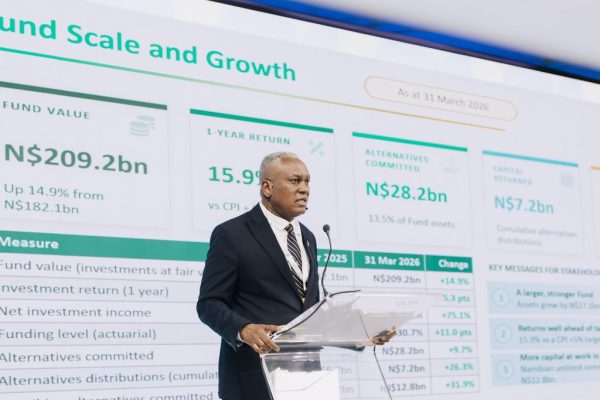
Presenting at the Pension Investment Symposium last week, the Government Institutions Pension Fund (GIPF), Chairperson, Board of Trustees, Penda Ithindi, has asked the business community and project initiators to bring bankable and well-governed opportunities.
The Symposium was meant to define, using evidence, what investment readiness requires for GIPF and its peers to invest wisely, at scale and with confidence in Namibia and the region.
According to Ithindi, investment readiness requires regulatory conditions to be clear, stable rules that hold over the life of the investment.
Namibia has been characterised by policy and regulatory uncertainty as the country struggles to clear its legislative backlogs through amendments, repeals, and drafting new relevant pieces.
GIPF has indicated that in the absence of certain enabling policies in the unlisted space, such as a rulebook for unlisted investing, it had to pioneer its own rulebook, the Unlisted Policy in 2008.
The Unlisted Policy helped shape the country’s Regulation 28 and 29.
Moreover, enabling more of the country’s savings to be invested locally. Currently N$100.3bn (48%) is in Namibia vs the 45% minimum.
Another hindrance to capital deployment is project governance.
Ithindi noted that capital does not like ambiguity and governance gaps.
He advised that entrepreneurs and project initiators adopt transparent ownership, credible boards, and bankable structures.
Ithindi also explained that the pension fund needs projects that are investable, not concepts.
Furthermore, those who need capital need to be ready to share a certain level of risk rather than just passing it on to the owner of capital.
He said risk needs to be sensibly shared between public, concessional and institutional capital.
Ithindi noted that more capital can be unlocked to work in Namibia provided the mentioned conditions are in place.
Currently, Namibian unlisted commitments are up by 31.9% to N$12.8bn.
However, the country still has N$5.1billion in committed capital for the unlisted sector which is committed but not drawn.
The capital seeks quality investment which can deliver risk-adjusted returns that are fair for pension fund members who are providing the savings.
GIPF has also contributed to the country’s ability to manage its savings with a seeded initiative of Namibian managers under Reg 29.
Now the country has more trained staff and IC in unlisted, with 29 managers, that have 45 mandates to deploy capital across sectors.
The Fund acknowledged that Namibia has investment opportunities with its energy endowment, including potential oil developments, which could support long-term growth.
Moreover, regional collaboration is also possible as Southern Africa’s capital markets become increasingly connected.
“We will explore regional partnerships & co-investment to share expertise and widen opportunity,” the Fund’s leadership stated.
The Symposium was meant to position Namibia for institutional capital and prepare the market for investment that drives development and impact.
To build a lasting understanding of market readiness and of how policy, legislation and development plans can shape an investment environment that serves present and future generations.
Moreover, it was meant to build momentum towards functioning market-making infrastructure that connects Namibia’s available capital with a pipeline of investment-ready opportunities.