

By: Nghiinomenwa-vali Hangala
As Namibia continues to seek investments, trade partnerships, and more markets to diversify and structure its economy, the country has employed various tools to market itself and attract investors and open new markets.
One of the various tools that the country uses to promote its interests, unlock trade, and secure markets is by opening embassies, high commissions, consulates, and also having trade attachés in various countries.
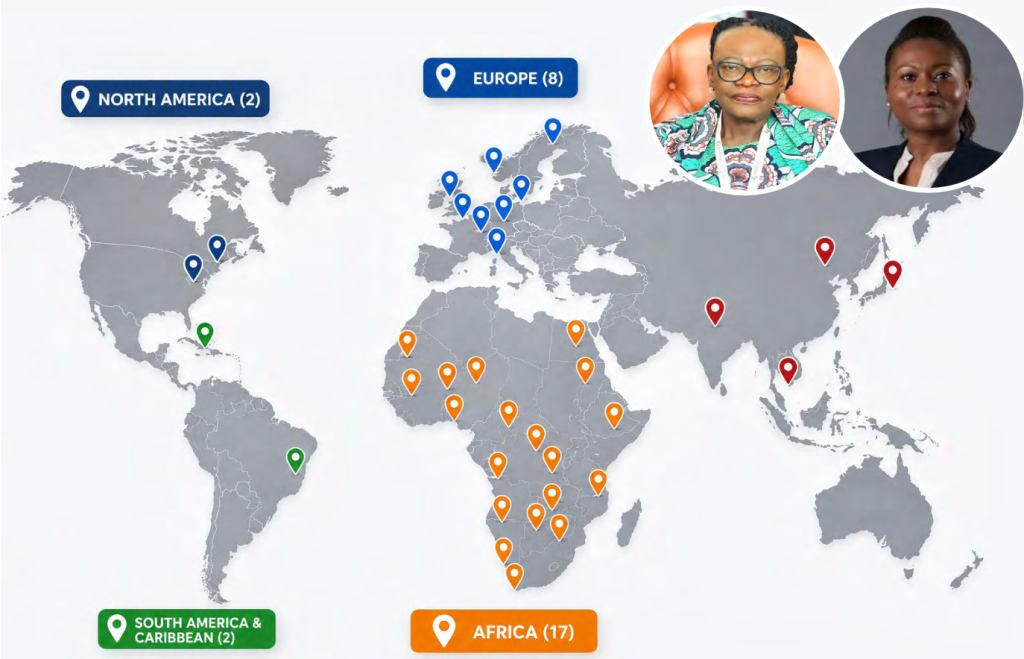
The country currently has more than 32 embassies, high commissions, permanent missions to international organisations, and consular posts around the world.
These offices not only promote Namibia’s economic interests, but also assist Namibians (entrepreneurs and others) who are looking for opportunities around the world.
The Villager reached out to the Ministry of International Relations and Trade (MIRT) for an updated list of the country’s presence around the world in terms of promoting its economic interests and others.
According to the executive director of MIRT, Ndiitah Nghipondoka-Robiati, as of 2026, Namibia maintains a network of diplomatic missions abroad, under the Ministry.
These missions comprise embassies, high commissions, permanent missions to international organizations, and consular posts, she stated.
Nghiipondoka-Robiati explained that 33 missions advance Namibia’s foreign policy objectives, promote trade and investment, and strengthen bilateral and multilateral relations.
Furthermore, they provide consular services to Namibian citizens abroad.
The executive director has also clarified that Namibia does not maintain a separate system of standalone trade attaché offices abroad.
Instead, trade promotion functions are undertaken by all embassies and high commissions, which have designated commercial or economic officers.
Out of the 33 missions, 17 of them are in Africa: Algeria, Angola, Botswana, Congo (Brazzaville), Democratic Republic of the Congo, Egypt, Ghana, Nigeria, Senegal, South Africa, Tanzania, Zambia, and Zimbabwe.
Despite many of Namibia’s missions/facilitating offices being in Africa, there is minimal trade and travel from such countries. Namibia mostly trades with South Africa, Zambia, Botswana, and the DRC.
Eight of these facilitating offices are in Europe: Austria, Belgium, Finland, France, Germany, Sweden, Switzerland, and the United Kingdom.
The European market is one of the main consumers of Namibian tourism services, beef, grapes, and other products. At the same time, Namibia imports pork and poultry products, among others.
They are also some of the main investors in various sectors, with European commissions in Namibia facilitating connections and investments.
Namibia has, however, struggled to utilise the trade agreements with EU markets to get more Namibian products to Europe beyond beef and grapes.
Namibia also has less of a presence in Asia despite the size of the continent, with only four (4) offices (embassies and high commissions) in China, India, Japan, and Malaysia.
China has also emerged as one of Namibia’s biggest trading partners. However, beyond China, the country has fewer trading partners in Asia, with India coming through as one of the partners, especially in pharmaceuticals.
In South America, Namibia’s presence and facilitating offices are just in two countries: an embassy in Brazil and in Cuba.
In North America, all Namibia’s mission offices are in the United States of America.
The Namibian economy has been heavily linked to the South African economy due to SACU and other factors, with most of its import needs coming from its southern neighbour.
Furthermore, Namibia’s export basket is also stubbornly dominated by a few minerals, with minimal diversification.
Countries use embassies, high commissions, and consulates to find markets and connect their entrepreneurs to different investment opportunities.
U.S. Ambassador to Namibia, John Giordano, has been making waves travelling around the country, especially in sectors aligning with America’s focus on Namibia’s energy sector.
Some Namibians have called for the Namibian representatives outside to emulate the same approach in promoting Namibian economic interests and enable access to new markets beyond SADC and the mineral trade.