




By: Nghiinomenwa-vali Hangala
For the financial year (FY) started in April 2024 and ended March 2025, the Development Bank of Namibia (DBN) approved N$912.7 million in funding across priority sectors, an increase compared to the previous year’s approval of N$906.1 million.
This was distributed through 128 loans approved during the 2024/25 FY, compared to 141 loans in 2023/24, according to DBN’s Annual Report.
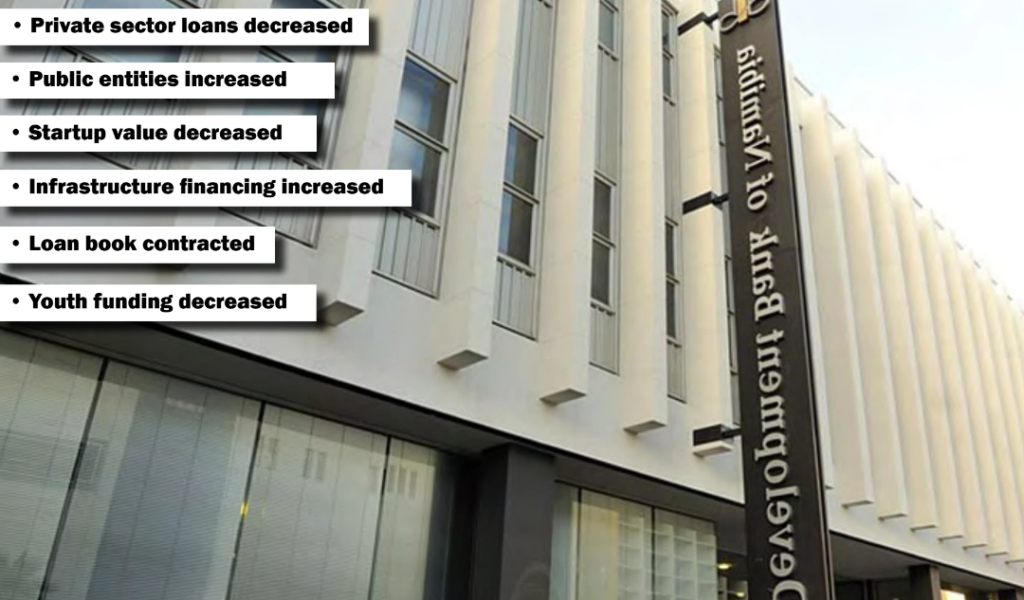
The loans are extended to various economic agents such as the private sector (big and small enterprises) and public entities. Approvals to the private sector totalled N$562.7 million in 2024/25, a 0.4% decrease from the N$564.7 million recorded in the previous year.
Meanwhile, public sector approvals were higher by 2.6%, from N$341.3 million in 2023/24 to N$350.0 million in 2024/25.
Access to capital enables businesses to expand by means of acquiring machinery, technologies, and hiring more employees, to mention but a few.
DBN loan approvals supported the creation of 1,299 jobs (512 permanent and 787 temporary), contributing directly to Namibia’s socio-economic development. This was a reduction compared to the last financial year’s creation of 1,939 jobs (717 permanent and 1,222 temporary).
The Bank also funded 49 SME projects to the tune of N$74.6m during the 2024/25 FY. Loans for women-owned enterprises amounted to N$51.5 million (9.2% of private sector approvals), while youth-owned businesses received over N$24 million in financing.
The value of these youth loans decreased compared to N$42 million approved in the previous year.
The Development Bank also financed 15 startups, with N$17.1 million in loans approved in 2024/25, compared to 16 start-up loans totalling N$233.1 million in 2023/24.
In 2024/25, infrastructure approvals totalled N$646.6 million, doubling from the previous financial year’s total approval of N$319.1 million.
The bulk of the infrastructure loans were directed towards social infrastructure (N$399 million; 61.7%) and utility infrastructure (N$209 million; 32.3%). Land servicing accounted for N$38.6 million (6%), while no approvals were recorded for commercial infrastructure.
Another observation made in the report is that the Bank’s loan book experienced a contraction from N$6.2 billion in 2023/24 to N$5.8 billion in 2024/25.
According to the Bank’s explanation, the reduction was primarily driven by accelerated cash sweeps linked to the National Energy Fund (NEF) exposure, which is servicing the oil storage loan.
The oil storage loan accounts for a significant portion of the loan book, with subdued new disbursements reflecting weaker pipeline conversions and write-offs of long-outstanding non-performing accounts, the Bank stated.
Despite the contraction in the loan book, the Bank’s total assets were valued at N$7.3 billion, supported by a higher cash position, which offset the decline in the loan book.
Potential risks included mandate drifts or undue external influence on DBN’s mandate, conflicting stakeholder goals, sovereign credit downgrades, and broader financial sustainability pressures.
Non-compliance risks (e.g. sanctions, fines), reputational losses, or financial penalties were top concerns. Inadequate digital automation of compliance can also lead to lapses.
At the same time, the Bank highlighted that ongoing regulatory changes pose an operational risk if managed inadequately.